
 | 30 Jan 2026
Weather intelligence – transforming economies
David P. Rogers
Alan J. Thorpe
Melanie S. Kappes
Anna-Maria Bogdanova
Human endeavours are becoming ever more sensitive to the weather in a changing climate. Accurate and timely forecasts and warnings of weather and its impacts provide valuable intelligence to take actions and to avoid harm. Furthermore, weather intelligence increases economic productivity enabling businesses and other enterprises make more efficient decisions. The quality and richness of weather intelligence is increasing substantially because of scientific and technological advances in areas such as remote sensing, modelling and simulation, data science, behavioural science and artificial intelligence. These advances are happening alongside the digital transformation of economies and societies, presenting a unique opportunity to integrate weather intelligence with the digital transformation. Realising the full value of weather intelligence in this context needs diverse data resources to be brought together and it requires collaboration among private, public and academic sector actors in the global weather enterprise including National Meteorological and Hydrological Services (NMHSs). Here we examine how the opportunities arising from innovative science and technology and the digital transformation of economies can be exploited to enhance decision-making for societal benefit. Whilst these general considerations apply to many countries and regions, here we discuss their application within South Asia.
- Article
(389 KB) - Full-text XML
- BibTeX
- EndNote


The resilience of economic growth largely depends on the digital transformation, often referred to as the digital economy. This transformation enables the integration of diverse data sources to support decision-making. Within this digital economy, complex inter-relationships among supply chain partners, driven by diversification and enhanced connectivity, allow for more effective responses to market demands and challenges (Lin et al., 2021). Many of these value chains and supply chains are sensitive to weather impacts and therefore would benefit from incorporating “weather intelligence” in their decision-making processes. In this context, “weather intelligence” is the ability to acquire, interpret and effectively apply weather and climate knowledge and skills to inform decision-making. Weather intelligence can be combined with a wide range of digital information relevant to societal and economic aspects that are sensitive to weather and climate conditions. Embedding weather intelligence into decision-making, enabled by the ongoing digital transformation, offers significant opportunities for economic growth and the protection of life and infrastructure (WMO, 2015).
We envision economies that can support the well-being of their populations and can absorb future shocks that would otherwise be deleterious and even calamitous. Achieving this vision requires creating conditions to strengthen the interconnectedness of social, economic, and environmental factors; increasing social cohesion at subnational, national and regional scales; investing in and creating economic opportunities and innovation; valuing cultural diversity; and creating and ensuring that all have the adaptive capacity to change. It is our contention that weather intelligence can play a crucial role in helping economies create those conditions, providing opportunities to increase social and economic resilience against the impact of extreme events, whilst at the same time optimising economic performance. While weather information already plays an important societal role, unlocking the full potential of weather intelligence for digital economies depends on a range of policies and actions. These include investment in technology by public and private sectors, open data policies (Rogers and Tsirkunov, 2021) that foster new insights that inform decisions, and greater devolution of decision-making that promotes inter-agency collaboration, public-private-people-academic engagement in all aspects of the value chain, and the co-production of truly integrated services. To examine how advances in weather, climate and hydrological services coupled with the digital transformation of societies could improve the resilience and quality of social and economic development in a particular region we consider South Asia.
2.1 Science and technology
Underpinning advanced weather intelligence is the significant progress in science and technology aimed at creating digital weather and climate services. These advances have led to more detailed and accessible data, enhanced forecasting models, and improved information, including about the uncertainties in the intelligence, and services for users across various sectors. Innovation has taken place and is progressing at pace across physical science of the atmosphere and oceans; new observing techniques to measure key variables of weather systems; enhancing the mathematical methods to predict the weather using machine learning; and development of computational technologies including supercomputer chips and cloud computing.
Here we expand upon four areas of scientific and technological developments to provide examples of how they will enhance the societal benefits that can be derived from weather intelligence:
-
Downscale global data using post-processing techniques enhanced by machine learning. This approach leverages state-of-the-art global weather data to produce detailed local weather intelligence while minimising systematic biases. By applying machine learning techniques, the process becomes more cost effective and potentially more accurate than developing and maintaining an additional regional weather prediction model. This method takes advantage of the high resolution of current and planned global weather data, making it a practical alternative for localised weather prediction (Nath et al., 2024).
-
Quantitatively predict the confidence that can be ascribed to predictions of possible future weather parameters and events. Ensemble forecasting provides an approach for estimating the likelihood of possible future weather events, offering a range of potential outcomes rather than a single deterministic prediction (Bauer et al., 2015). Business decisions should be informed by understanding financial and non-financial costs of action versus inaction. Reliance on a single forecast is akin to navigating with tunnel vision, assuming it will be correct every time, an impractical assumption given the inherent uncertainties in weather forecasting. Ensemble predictions provide more comprehensive weather intelligence on the full range of possible future events so that costs and losses can be fully and properly considered prior to the decision being made with a larger ensemble size providing significant benefit (Richardson, 2001). By considering the confidence levels across a spectrum of possible outcomes, businesses can make more informed decisions, fully aware of the risks involved (Leutbecher and Palmer, 2008).
-
Provide Integrated Data Services. To fully leverage the predictive power of weather and climate data, integrating diverse data sources is essential. Currently, data sources remain largely disconnected, with national policies often discouraging the data sharing needed to construct a comprehensive model for understanding the impact of weather and climate risks. The concept of integrated services, as outlined by Thorpe and Rogers (2021), emphasises the importance of merging meteorological data with non-meteorological data residing in various unconnected repositories across different economic sectors. Achieving this integration requires significant software development to bring disconnected data sources together giving due consideration to data security issues and privacy issues. Here the machine learning approaches can play a role in searching for data and providing required business intelligence by analysing vast array of data from various data sources. This approach is crucial for identifying and quantifying the impacts of weather intelligence throughout the economy.
-
Establish and sustain high-quality meteorological observation Data. National data sources play a critical role in supporting high-quality meteorological observations that are essential for capturing local weather phenomena impacting the nation's economy and society (Grimes et al., 2022). These observations have multiple benefits, including assimilation in forecasting models, serving as training data for machine learning algorithms used in the post-processing of weather data and in integrated service models. Additionally, they provide evaluation benchmarks for assessing and enhancing the accuracy of global forecasting models. However, the true value of these local observations can only be realised when accompanied by the broader digital transformation efforts discussed earlier. Without such comprehensive integration and digital upgrades, the potential of local meteorological observations remains significantly underutilised.
The impact of these digital transformations in weather and climate can be seen in two main areas: (a) enhanced access to internationally produced weather and climate intelligence and (b) enhanced capabilities to manipulate and utilise such intelligence at the national or regional level. In this section, our focus is on scientific and technological developments, while other critical factors, such as governance, market structure, and legal matters, are discussed later in this paper.
Many public and private organisations are world leaders in producing global weather and climate intelligence, available either free at the point of use or at a commercially affordable rate1. These organisations provide weather intelligence across national and regional boundaries, a capability significantly enhanced by digital transformations. Consequently, it is crucial for countries and institutions to avoid duplicating these existing services, which often come at a higher cost and result in lower quality outcomes and instead leverage the wealth of resources available globally.
In this context, in-country capabilities, as outlined in (b) above, become both a priority and cost-effective strategy. These in-country capabilities require enhanced training of the skills necessitated by digital transformations, along with the provision of necessary computing and networking resources suitable for effectively utilising global weather intelligence. In addition, local investment can be made to enhance in-country capabilities to develop weather intelligence specific to the local context.
2.2 Utilising weather intelligence
Weather intelligence when combined with societal and economic data creates actionable insights and solutions to help improve decision-making, reduce risks, enhance resilience, and optimise performance for various sectors such as agriculture, energy, health, transport, water, and disaster management. It is a key contributor to the achievement of the Sustainable Development Goals (SDGs) (https://wmo.int/activities/sustainable-development-goals, last access: 28 January 2026) and the Paris Agreement on climate change (https://wmo.int/news/media-centre/global-temperature-likely-exceed-15degc-above-pre-industrial-level-temporarily-next-5-years#:~:text=Under the Paris Agreement%2C countries,the end of this century, last access: 28 January 2026). However, weather intelligence is not only a matter of technical or scientific endeavour. It also requires the engagement and collaboration of different actors and users who have different needs, expectations, and capacities such as citizens, sectoral experts, psychologists, behavioural scientists, communication experts, policymakers, practitioners, and weather service providers. Co-design and co-production of weather intelligence based on mutual learning, trust, and ownership among all involved actors, helps to create integrated services that are tailored, usable, and impactful (https://www.dwd.de/EN/research/researchprogramme/idea_s4s_network/science_for_service/project_co_design/project_co_design.html, last access: 28 January 2026). For example, early warnings based on weather intelligence enable communities to prepare for climate hazards by delivering timely risk assessments and guidance, strengthening both disaster preparedness and long-term adaptation (Davies et al., 2025) (https://www.resurgence.io/daraja/, last access: 28 January 2026; https://www.metoffice.gov.uk/binaries/content/assets/metofficegovuk/pdf/business/international/wiser/wiser-co-production-guidance.pdf, last access: 28 January 2026). In the energy sector, weather-informed forecasting helps producers and distributors better manage electricity supply and demand, particularly from renewable sources, while minimizing infrastructure damage from extreme events. Farmers and agribusinesses can use weather data to optimize planting schedules, reduce water and fertilizer usage, manage pests and disease, and mitigate climate-related losses – while also accessing weather-indexed insurance and meeting sustainability standards. In transport, road and logistics operators rely on weather forecasts to adjust routes and schedules, improve passenger safety, and reduce fuel use and emissions. Across these examples, the integration of weather intelligence with sector-specific knowledge enables tailored, timely, and impactful solutions for diverse stakeholders.
These and many more examples require the ability to combine weather data with other relevant data to generate new insights and translate them into actionable and timely information and recommendations that can be effectively communicated to relevant stakeholders.
3.1 Digital transformation: opportunities and challenges
Digital transformation is a key driver and enabler of economic, social, and environmental progress, offering many opportunities and benefits for a region's or country's development, sustainability and resilience. It provides an opportunity to enhance the quality and accessibility of critical information, thereby empowering people and communities, especially the marginalised and vulnerable groups, such as women, youth, rural poor and ethnic minorities. However, it also entails many technological, economic and social risks and challenges, including developing and maintaining high-speed internet networks, data centres and high-performance computing infrastructure, all of which require substantial financial investment (Haryanti et al., 2023).
It is important to facilitate digital transformation in a way that information is tailored to the specific needs of individuals and organisations by adopting a co-design and co-production approach with end users. Access to critical information may be facilitated through intermediaries such as local officers and extension workers to avoid digital exclusion in areas with poor digital public infrastructure (Sugihono et al., 2022). While NMHSs are responsible for providing warnings, these local officers are typically responsible for disseminating and communicating timely, actionable data and information relevant to the communities' daily activities and planning. A participatory approach will secure buy-in from the stakeholders and should integrate multiple data sources to assist decision makers in analysing the data, generating alternative solutions and evaluating outcomes.
These issues along with national data sharing and governance policies, demand careful and coordinated responses from various stakeholders, including government agencies and ministries, businesses, civil society, and international organisations. It is imperative to foster a conducive and inclusive digital ecosystem that can harness the potential of digital transformation for everyone.
3.2 Weather intelligent decisions
The availability of vast amounts of data has transformed decisions. Decision-makers can rely on data analytics to make informed decisions leveraging insights through the ability to combine data from a wide range of sources and are increasingly using artificial intelligence knowledge-based techniques (Soori et al., 2024; Bari et al., 2023). Embedding weather intelligence allows decision-makers to leverage weather information and insights into their decision processes. This can enhance the quality, timeliness, and effectiveness of the decisions, as well as improve outcomes and impacts.
Despite their sensitivity to the weather, many businesses cannot make effective use of weather intelligence in their decision-making processes for a variety of reasons. Weather impacts on business may not be well documented or understood resulting in a tendency to discount weather intelligence, particularly for day-to-day impacts on consumer behaviour and supply chains. Weather data can be scarce, incomplete, inconsistent, or inaccurate, especially in remote or complex areas, or in extreme weather conditions, which affects the reliability and validity of the weather data and information. Weather data can be heterogeneous, diverse and dynamic, and require different formats, standards and protocols for integration and interoperability with other relevant data and models. It can also be voluminous posing scalability challenges in embedding weather data in decision-making processes. And perhaps the most significant challenge highlighted by users is the difficulty in interpreting and applying weather intelligence effectively. This problem is pervasive in developing countries.
In contrast to the business community, disaster management relies on the ability to combine weather intelligence in the form of impact-based forecast and warning services (e.g., Sene, 2024; Golding, 2022) with decision support tools (e.g., Cioca and Cioca, 2010) for hazardous situations. This enables decision-makers to gain a more comprehensive and accurate understanding of the current and future hazards and risks, as well as the vulnerabilities and capacities of affected communities, systems and infrastructure. This can help them identify the most critical and urgent issues, distinguish those people at-risk requiring intervention, prioritise actions, and allocate resources accordingly. By integrating the analytical and evaluative capabilities of decision support tools with weather intelligence, decision-makers can generate and compare different scenarios and options and select the most optimal and feasible solutions. Moreover, by linking these outputs to the relevant stakeholders and actors, such as emergency services, civil protection agencies, media, and the public, decision-makers can ensure a timely and coordinated response and reduce potential conflicts and confusion.
Whether for business decisions or public safety, a prerequisite in the development of the weather intelligent decision support tools is the involvement of users and stakeholders in the definition of the problem and the design of the tools to meet their needs and expectations. Common protocols and criteria are needed for data and information quality and compatibility and to adopt interoperable and harmonised systems and platforms. Policies are also needed for data use and exchange and adhere to strict data protection protocols since access to personal data may be required to effect actions to protect individuals at risk. Decision support and weather intelligence may involve different actors, roles, responsibilities, and interests, which may create conflicts, gaps, or overlaps in their functions and objectives. Whether in the public or private sector, it is important to invest in the human and technical capacities and resources for weather intelligence and decision support integration, and to provide adequate training, support, and incentives for the involved staff and personnel.
3.3 Personalised decisions
NMHSs are responsible for issuing weather warnings to all aspects of society. These warnings are for extreme or impactful weather that could detrimentally affect people and infrastructure. Weather warnings are frequently graded by the severity of the weather event and potential or expected impacts. The current universal approach involves broadcasting impact-based weather warnings to whomever is able and motivated to receive them. They contain weather intelligence but are not tailored for the recipient, as the NMHSs are unaware of the identity of the recipients and therefore cannot address their specific needs.
Consequently, weather warnings are an essential but insufficient component of what is needed for decisions to be made for any action to avoid the impacts of the severe weather. While significant steps have been made using mobile technologies (e.g., Paul et al., 2021; Emileva et al., 2023), currently they do not and cannot account for the specific situations and vulnerabilities of individual recipients.
One solution to this deficiency is for the weather intelligence to be merged with each person's relevant circumstances such as exact location, condition of specific infrastructure, current and future activities, financial situation, disabilities, special needs, etc. Such a range of information is only likely to be known to the individuals themselves. Personal data protection laws would in any case prevent a third party from having access to such information. Therefore, at an individual level, whilst civil protection advice is typically available and important, it is up to individuals to merge the weather intelligence with their personal data to form their own decisions for action. However, such “personalised decision support” would require a user-aware model that considers personal factors relevant to the weather event being warned about. This could foster greater trust in digital services, as evidenced by recent literature highlighting the importance of data ownership and privacy in technology adoption (Lutz and Newlands, 2021; Mols et al., 2022).
This opens the opportunity for the development of specially designed apps on smartphones that could store these person-specific data with local encryption and password protection. Such an app needs to possess the ability to continuously model the user context, potentially using machine learning tools, to suggest the appropriate decision and action that an individual should take in the event of specific weather alerts and warnings. This could herald an era of Personalized Decision Support (PDS) enabled by digital information and machine learning software.
In this paper, we emphasise the benefits and challenges of co-design and co-production of weather intelligent integrated services. These require a partnership between relevant actors that can potentially contribute to a given service (Golding, 2022). We recognise that partnerships between public, private and academic sector actors are a challenge with many perceived and real barriers to their success. But there are examples of success that can be built upon. One such is the Natural Hazards Partnership (https://www.metoffice.gov.uk/services/government/environmental-hazard-resilience/natural-hazards-partnership, last access: 28 January 2026) in the UK, which is focused on weather-related hazards. Other examples include the situation in Japan where public-private engagement has resulted in a weather business consortium to promote the uptake and use of weather by small, medium and large enterprises and the Living-Labs concept, which has been applied by the University of Salford to create a physical space to support multi-disciplinary activities. The main purpose of these activities is to bring people together to explore opportunities to better exploit weather intelligence in day-to-day decision-making. We have argued here that weather impacts most people, often with significant social and economic consequences, and weather intelligence can be used both to mitigate adverse impacts as well as increase economic performance and resilience.
4.1 International cooperation
The production of weather intelligence relies on a very high degree of international cooperation with an obvious example being the design and execution of the global observing system. Many countries and institutions make routine real-time observations of the global weather system, and these observations are widely shared across national and institutional boundaries. Making global or indeed regional weather predictions would be impossible without the collection of and sharing of the real-time observations made globally. This cooperation and interdependence make it meaningful to talk about a global weather enterprise. There are several international and intergovernmental organisations that have been established to facilitate this cooperation: for example, the World Meteorological Organisation (WMO) and the European Organisation for the Exploitation of Meteorological Satellites (EUMETSAT). Indeed, the European experience demonstrates that formal regional cooperation between nearby nations can yield considerable benefits, as exemplified by the European Centre for Medium-Range Weather Forecasts (ECMWF) (https://www.ecmwf.int/, last access: 28 January 2026). The ECMWF is widely regarded as a highly successful example of regional co-operation among NMHSs. A significant contributory factor to its success is that it operates as an intergovernmental organisation with a binding Convention setting out the mission and operating principles of the organisation. Member states contribute funds in proportion to their gross domestic income. As a result, member states and in particular their NMHSs delegate responsibility for the provision of certain key data and training to ECMWF. The member state NMHS retains the mission to provide national observations, forecasting and warning services for users. This creates a symbiotic relationship.
4.2 Weather Business Consortium
Weather intelligence for private businesses can be defined as the combination of weather information and services, business data and analytics, and decision support tools to enhance the resilience and competitiveness of businesses in the face of weather and climate variability and change. The effective use of weather and climate data and information in commerce requires a proactive approach. Many businesses neither understand the risks associated with climate change nor the potential opportunities to benefit from the current weather to increase productivity.
In 2017, to reinvigorate its competitive weather services market, Japan created the Weather Business Consortium (WXBC) (https://www.wxbc.jp, last access: 28 January 2026) with the aim of promoting the use of weather data across multiple business sectors. By the end of February 2023, the consortium had over 1200 members from government, academia, and industry. It has two working groups: one focused on creating new weather businesses and one focused on human resource development. Their services include a Weather Data API catalogue provided by WXBC members and case studies on the use of weather data in various industries to help to create new connections with users. Examples of users and providers co-developing weather intelligent solutions because of the WXBC include (1) the utilisation of weather intelligence to optimize the operations of consumer electricity service, enabling users to consume electricity for free up to JPY 5000 per month. Weather intelligence is used to forecast demand and sales. Statistical modelling and AI-driven analysis combines electricity demand data, open data from major power companies and weather intelligence. Weather intelligence is used to predict electricity usage; analyse behaviour and consumption trends; and evaluate the impact of advertising on electricity usage. (2) The use of weather intelligence for efficient railway operation and management. Collaboration between the train company and a weather service provider created a weather intelligence informed decision support toolkit that enables the train company to stop operations before high impact weather events occur, avoid emergency stops and customer inconvenience. The approach also increased the awareness of the train company's staff to the impact of the weather. Future goals include expanding weather intelligence utilisation across industries and promoting systemisation of weather-related decisions. These case studies help potential users understand the value of weather intelligence and encourage them to adapt their business models to enable weather intelligent decisions.
Loosely based on the Japanese experience, it is possible to create a platform for small and medium-sized enterprises (SMEs) to engage with public, private, and academic providers of weather-, water- and climate-related products and services. This would enable SMEs to find solutions using weather intelligence to minimise risks and maximise opportunities related to the impact of the weather and climate on business operations and planning. It would be an opportunity for public institutions, including NMHSs, to understand better the requirements of SMEs and to develop and adapt services accordingly. Similarly, where solutions exist in the private and academic sectors, the consortium can act as a marketplace to make new connections between suppliers and users. There is a mutual benefit to increase understanding among suppliers and potential users of weather, water and climate information and services and to support human resource development across the spectrum of users and suppliers.
The main purpose of the consortium is to drive commerce involving the intensive use of weather intelligence to increase business productivity including the use of new technologies such as the Internet of Things (IoT) and Artificial Intelligence and Machine Learning. This collaborative approach should underpin and strengthen competitive domestic markets increasing opportunities for new entrants as well as engaging fully a country's NMHS in developing and sustaining economic growth. Access to NMHSs' weather data would be critical to fulfilling the aims of the consortium. While some may consider this a risk to the public sector, by providing these data as open data, both SMEs and large companies can leverage it to enhance their own data services, utilise meteorological data for business purposes, offer data analytics and information systems, and establish new businesses. While a business consortium would need to operate at the national or subnational level, creating a prototypical platform at a regional scale would address concerns about which countries would have the capacity to begin this type of venture. Collectively, the joint learning experience would help minimise any perceived risks to individual firms and could treat the exercise as a lean start-up.
4.3 Natural hazards partnership
For any country to better prepare and respond to more challenging and extreme natural hazard events, the delivery of efficient, user-oriented services must be rooted in the latest science and communicated through efficient channels. This can only be achieved through a working partnership of many actors with different expertise. While the WXBC focuses on businesses as the economic drivers of the economy, the whole of society needs to engage in the process of turning data about hazards into impact-oriented information, making decisions and taking anticipatory actions to protect lives and livelihoods. In some countries, the approach is disjointed, which means that scientific information is not translated appropriately into actionable and useable information for beneficiaries. There is a need for stakeholders from many different parts of society to work together to share requirements, data, research, and analysis to co-design and co-produce information and warning services for planning and anticipatory action. The Sendai Framework for Disaster Risk Reduction 2015–2030 (https://www.preventionweb.net/files/43291_sendaiframeworkfordrren.pdf, last access: 28 January 2026) places the State at the heart of disaster risk reduction but also emphasises the role of all stakeholders both government and private sector (Rokhideh et al., 2025). By extension, this includes other non-governmental actors, such as Red Cross and Red Crescent Societies that play a critical role in enabling anticipatory action to mitigate or eliminate disasters (https://www.climatecentre.org/priority_areas/fbf-ibf/, last access: 28 January 2026).
As an example of a best practice, the UK Natural Hazards Partnership (NHP) is a collaboration of government departments and bodies to provide authoritative, consistent, and useful, hazard, impact and risk assessment information to responder communities and governments (Hemingway and Gunawan, 2018). It has allowed the development of strong leadership and inter-organisational coordination practices and a common approach to scientific research to produce value products, services and advice. A key element of the success of the partnership is the advocacy and support it receives from the office of the UK Prime Minister (Cabinet Office). Each entity is recognised for its contribution to the collective effort of the partnership. The approach has been recognised by the UN as a model that other nations may wish to adopt (UNISDR, 2013). The approach could also be applied more broadly to strengthen economic productivity through collaboration between government and private sector by, for example, hosting observations systems on private land, creating service level agreements, sharing responsibilities for verification, interpretation and communication of forecast products.
4.4 Living Labs concept
Living Labs are collaborative platforms where stakeholders engage in co-creation, experimentation, and evaluation of innovative solutions in real-life settings (ENOLL, 2025; Schuurman et al., 2015; Hossain et al., 2019; Lorenzo et al., 2021). They embody an open-innovation ecosystem that bridges the gap between research and practice, fostering user-centred design and participatory processes. The approach recognizes that, while many different tools exist, their application is often unique requiring solutions to be constructed and tested with users and beneficiaries in a practical, real-world environment. Applied to creating weather intelligence, Living Labs combine many of the elements of co-production, already described, to turn weather information into weather intelligence and to provide users with the ability to quantify the impact of a range of actions on social and economic outcomes (Davies et al., 2025).
This section discusses how the ideas presented earlier can be applied to a developing region of the World. Since 2018, the WMO World Bank and several bilateral development partners have worked with nine countries – Afghanistan, Bangladesh, Bhutan, India, Maldives, Myanmar, Nepal, Pakistan and Sri Lanka. Together, these form the South Asia Hydromet Forum (SAHF), which aims collectively to strengthen the region's meteorological and hydrological organisations and the services that they provide to their citizens. These services range from warnings of extreme weather events to helping economic actors make weather intelligent decisions. The rationale for the focus on South Asia is explained in Sect. 5.1 and 5.2, which is followed by a summary of ongoing work to apply weather intelligence with the business community in Sri Lanka.
5.1 Weather intelligence and the digital transformation of South Asia
South Asia is one of the fastest growing regions in the world with a population of about 2 billion and a nominal 2024 gross domestic product (GDP) of about USD 4.9 trillion with projected growth to USD 7.9 trillion by 2029 (https://www.imf.org/external/datamapper/profile/SAQ, last access: 28 January 2026). However, the region faces many development challenges, such as low per capita income, high poverty and inequality, poor infrastructure and governance, and vulnerability to climate change and natural hazards. South Asia's digital economy accounts for only about 6 % of its GDP, compared to 15.5 % in East Asia and Pacific, and 17.8 % in North America; however, there are signs of rapid digital transformation in the region (https://documents1.worldbank.org/curated/en/099230004062228270/pdf/P1723000e5e0d20908c790a5ffdda147f1.pdf, last access: 28 January 2026; https://openknowledge.worldbank.org/server/api/core/bitstreams/778a3dc7-9da1-5722-a128-50b6b2aa38d7/content, last access: 28 January 2026). The number of internet users in South Asia increased from 13.5 % of the population in 2010 to 34.5 % in 2019, while the number of mobile-cellular subscriptions increased from 52.8 % to 84.8 % in the same period. The region also witnessed a surge in mobile broadband subscriptions, from 0.4 % in 2010 to 25.5 % in 2019. South Asia has seen a proliferation of digital services and platforms in various sectors, such as e-commerce, fintech, e-government, e-education, e-health, and e-agriculture. For example, India's e-commerce market is expected to grow from USD 38.5 billion in 2017 to USD 200 billion in 2026, while in Bangladesh, a mobile financial service provider, has over 36 million registered users and handles over 80 % of the country's mobile transactions.
As this digital transformation expands, there are increasing opportunities to use weather intelligence. Weather intelligent digital agriculture is a relatively new concept in South Asia (Sankati et al., 2025) with huge potential. Sixty percent of the population of South Asia depends on agriculture as the main source of income and it contributes about 16 % of the region's GDP. Agriculture is highly dependent on monsoon rainfall since about 60 % of cultivation is rainfed. Weather and climate affect crop production, yield and quality, as well as livestock and fisheries sectors. Utilising weather intelligence more effectively is important for food security, nutrition, poverty reduction, and rural resilience (Naveen et al., 2024). Opportunities are emerging to integrate weather intelligence fully within digital agriculture decision support toolkits (https://wmo.int/media/update/global-partnership-channels-more-usd-1-billion-scale-weather-services-hundreds-of-millions-of#:~:text=The Ministry of Agriculture and,provide continued support to NMHS, last access: 28 January 2026). The region is also at high risk of exposure to extreme heat resulting in an increase in the risk of accidents and heat-related illnesses, such as respiratory infections, cardiovascular diseases and mental stress, which are increasing in South and Southeast Asia (Kim et al., 2023; Kyaw et al., 2025). Weather intelligence incorporated into decision support toolkits would help to understand and manage this exposure to avoid disrupting access and quality of health care services as well as the economy more generally (Liu et al., 2024).
5.2 Weather intelligent Sri Lankan businesses
The SAHF has created new opportunities for public-private engagement by providing a platform from which to build and test decision support tools needed to support and exploit the digital transformations discussed here. In Sri Lanka, digital transformation is underway across government and the private sector with a national investment of USD 10 million in 2025, aspiring to generate USD 15 billion in revenue through the digital economy within 5 years (Ministry of Digital Economy, Sri Lanka). This, and early initiatives aimed at increasing society's resilience to the impact of climate change, prompted the development of a pilot project by SAHF, in partnership with the Global Facility for Disaster Reduction and Recovery (GFDRR) (https://www.gfdrr.org/en, last access: 28 January 2026), the Global Weather Enterprise Forum (GWEF) (https://www.gfdrr.org/en/gwe/global-weather-enterprise-forum, last access: 28 January 2026) and the Ceylon Chamber of Commerce (CCC) (https://www.chamber.lk, last access: 28 January 2026). The pilot project engages with large enterprises and SMEs to increase their understanding of the value of weather intelligence for day-to-day business decisions and to increase the uptake of weather intelligence by businesses to increase their productivity and economic performance. Equally important is to identify the emerging needs of economic actors for weather intelligence as a factor in their planning and operational decisions. While the pilot project is still at a preliminary stage, it is recognised by the business community that weather intelligence could help improve their economic performance. An ongoing survey of large enterprises and SMEs and interviews with CCC sectoral committees, conducted between December 2024 and March 2025, highlight the challenges and opportunities in making weather intelligent decisions (Table 1). Commercial banks are investors in all sectors of the economy and have a unique perspective on the capacity of different sectors to use weather intelligence effectively. Since agriculture is a major part of the economy, its challenges feature across multiple sectors. Despite the availability of agrometeorological services for farmers, the bankers and insurers highlighted the lack of ability to interpret weather and climate information and the need for large, so-called apex, enterprises, to play a leading role in creating and communicating weather intelligence throughout their food value and supply chains.
Table 1Synthesis of interviews with representatives of four business committees of CCC, Sri Lanka. The overarching theme revolves around the challenges and opportunities in utilising weather intelligence to improve decision-making, reduce risks, and enhance economic resilience.
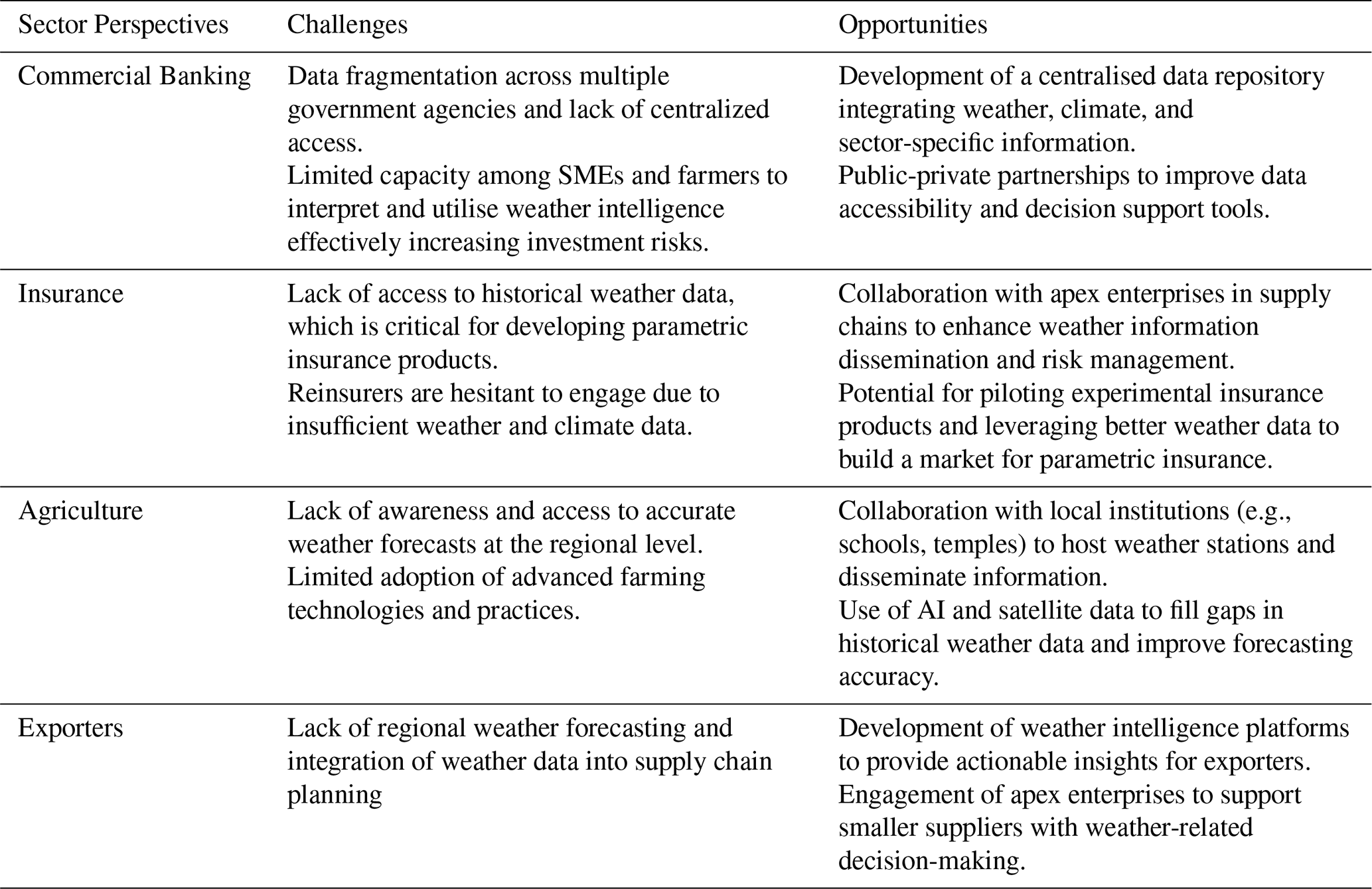
How to address this? The overwhelming majority of businesses surveyed and interviewed supported greater collaboration between government, private sector, and international organisations to improve weather data quality, accessibility and utilisation. They also advocated for policy changes to address data-sharing barriers; access historical weather data to create new products; and develop weather intelligent decision-support tools in collaboration with apex enterprises and other stakeholders. They also want to enhance awareness and technical capacity among SMEs, farmers and cooperatives to utilise weather intelligence effectively. This could be done by establishing a prototype weather intelligent decision-support platform thought the Chamber of Commerce to integrate and disseminate actionable data; and pushing for reforms in data-sharing policies to facilitate innovation (Rogers and Tsirkunov, 2021).
5.2.1 Decision support
Most existing weather intelligent decision support tools have been developed to aid governments to mitigate the impact of hazardous weather communities and manage disasters effectively. For example, TNSMART (Tamil Nadu System for Multi-Hazard Potential Impact Assessment, Alert, Emergency Response Planning, and Tracking) is a web-GIS-based decision support system developed by the Commissionerate of Revenue Administration and Disaster Management (CRADM) in collaboration with the Regional Integrated Multi-Hazard Early Warning System for Africa and Asia (RIMES). It aims to strengthen disaster management by transforming weather forecasts into actionable, impact-based early warning information. This system is being rolled out across many Indian states. MOBILISE is a digital platform, developed by the University of Salford, UK, to enhance disaster resilience and preparedness in Asia, focusing on countries like Sri Lanka, Pakistan, Malaysia, and the Maldives (ICSI, 2024). It aims to transition from reactive disaster response to proactive risk management strategies, emphasising collaboration among government agencies and stakeholders. The platform integrates diverse data sources, including exposure and vulnerability databases, sensor networks, weather forecasts, hazard models, crowdsourced information, and satellite imagery, to provide actionable intelligence for decision-making. Under the Climate Adaptation and Resilience (CARE) for South Asia Project, up to eight climate-informed decision support systems have been developed, principally to support agriculture, water, transport, national planning and disaster management for the governments of Bangladesh, Nepal and Pakistan. An underpinning component of these tools is the regional Resilience Data and Analytics Service (RDAS), which is a data and analytics platform developed by RIMES for resilient planning and investments in South Asia.
Can these tools be adapted to the specific needs of the business sector? RDAS, as a dynamic regional data repository for climate and sectoral datasets, could potentially be the source of baseline data needed for the development of local decision tools. MOBILISE enables controlled sharing of information through a data governance framework and cloud infrastructure, which ensure confidentiality. All the decision support tools described here have some form of real-time dashboard that integrate weather intelligence with a wide range of other data. Several of them enable communication through mobile applications, which can also be provided by telecom operators.
A key requirement of any tool employed is its ability to facilitate collaboration across social, economic and environmental dimensions. The work with the CCC highlights the interdependence of sectors, where the resilience of one sector is highly dependent on the resilience of another (Rogers et al., 2018). This implies that the solutions to improve the uptake and use of weather intelligence need to be holistic considering the cascading impact of decisions made by one stakeholder on another. For example, the Sri Lanka Department of Meteorology may issue a weather warning, which results in school closures authorised by the Department of Education. If the warning is not sufficiently early, the school closures may cause an unplanned disruption to a garment factory's production due to absenteeism with parents needing to stay home with their children. This highlights the importance of impact-based forecasting for anticipatory action and defining early warning in terms of cascading impacts on all parts of society. Similarly, weather intelligence influences decisions in the food supply chain from growers and hauliers to domestic and international markets, where weather impacts on one may have cascading impact on others. Particularly, where there is a nexus between public and private goods, it would be desirable for all decision-makers to have a common understanding of a situation to optimize actions across public and private sectors.
5.2.2 Opportunity
Based on the discussions and recommendations of the business community, and using the ideas outlined in Sect. 4, we plan to create a Weather Intelligence Living Lab with the CCC. This would take the form of a hybrid centre aimed at enabling business organisations make weather intelligent decisions. The Living Lab would, in practice, incorporate a version of the NHP to encourage the engagement of national and local government representatives with access to critical social and environmental data and businesses with access to economic data. It would create a centralised access point for data and provide a collaborative environment for the co-design of solutions of use to all the partners in the Living Lab. This could link to a new activity financed by the Climate Risk and Early Warning Systems (CREWS) initiative, which includes the development of a support centre for decision support systems within SAHF. This would enable new weather intelligent tools to be built based on access to ECMWF products, the RDAS, MOBILISE and other methods. Evaluation of the impact of incorporating weather intelligence in business would follow existing management practices, which use the concept of Integrated Thinking and Reporting (https://www.ifrs.org/news-and-events/news/2025/05/tokyo-takeaways-2025-integrated-thinking-reporting-conference/, last access: 28 January 2026) to quantify how value is created, preserved or eroded within an organization.
This paper has outlined a way to accelerate social and economic resilience by incorporating weather intelligence in all weather-sensitive decisions. The opportunity to do so is aligned with the ongoing digital transformation of societies and the growing access to data from many disciplines and societal actors. It challenges the status quo by highlighting the need for weather information that goes well beyond the requirements of basic forecasting and the public task of NMHSs. It requires a more expansive view of the weather enterprise incorporating the skills of the public sector with those of the private sector and academia (see World Bank, 2019); and critical engagement with decision-makers, everyone, whose actions can be better informed by incorporating weather intelligence. To realise such a system requires significant public and private investment in the region to realise the full potential of advances in science and technology, regardless of their origin. It demands a strong public sector, underpinned by open data policies, along with a cooperative private sector that can build on the public investment in NMHSs to offer commercial services to businesses. This partnership, can in turn, enhance public sector services.
The analysis presented in this paper suggests several actions for more effectively incorporating weather intelligence in various aspects of decision-making in many countries (including those in South Asia). These actions2 can be summarised as:
6.1 Investing in the digital economy
-
Assess the digital transformation trends within society and the economy including internet penetration and mobile connectivity, growing digital services and computing platforms, and the emergence of digital innovation and entrepreneurship. This would highlight the immediate opportunities as well as the need for investment to improve the uptake and use of weather intelligence by everyone impacted by the weather. National computing facilities and/or access to commercial cloud computing services are potential ways to serve a range of users including NMHSs.
-
Improve access to high-quality weather-related information available from global sources by forging appropriate access arrangements with information-producing organisations and centres. These arrangements include national computing and networking capabilities as well as international bilateral and multi-lateral agreements.
-
Establish suitable training opportunities for indigenous workers in the areas of scientific and technological expertise that form the basis of the digital transformation. This includes training in the science and utilisation of weather intelligence, as well as machine learning and computing. It is essential to incorporate training opportunities for potential users of weather intelligence in decision making processes.
6.2 Use of public-private-academic engagement
-
Utilise the weather enterprise involving public, private and academic sectors through the GWEF recognising that creating this intelligence goes beyond the forecasting services that can be provided by any one sector alone.
-
Establish national partnership bodies that provide forums for academic, public and private sector organisations to work collaboratively and build mutual trust.
-
Build a weather marketplace throughout the region by developing consortia comprising public and private providers of weather information and potential users of weather intelligence to promote the co-design, co-development, and co-production of integrated weather-sensitive services by public, private, and academic entities.
6.3 Enhancing government policies and investments
-
Create national regulatory and legal frameworks that provide clarity and market stability for businesses that provide widely accessible data to enable integrated weather-sensitive services to grow and thrive.
-
Invest in national meteorological and hydrological services that can ensure appropriate weather warnings are issued to protect lives and livelihoods. Additionally, maintain the necessary national weather infrastructure including weather and climate observations to provide weather information freely to all who can benefit from it.
-
Provide governmental and financial support for national contributions to regional multi-national initiatives to provide weather services that transcend what an individual country can provide from its own resources.
Whilst the need for these actions is evident, the challenge is substantial. Greater financial investment is essential, particularly in the public sector, but this must be accompanied by reforms that create new opportunities for the entire weather enterprise removing real or perceived barriers.
No data sets were used in this article.
DPR and AJT prepared the manuscript with contributions from all co-authors.
The contact author has declared that none of the authors has any competing interests.
Publisher's note: Copernicus Publications remains neutral with regard to jurisdictional claims made in the text, published maps, institutional affiliations, or any other geographical representation in this paper. The authors bear the ultimate responsibility for providing appropriate place names. Views expressed in the text are those of the authors and do not necessarily reflect the views of the publisher.
This article is part of the special issue “EMS Annual Meeting: European Conference for Applied Meteorology and Climatology 2024”. It is a result of the EMS Annual Meeting 2024, Barcelona, Spain, 2–6 September 2024. The corresponding presentation was part of session ES2.2: Communicating science and dealing with Uncertainties.
The authors are grateful for the insights of colleagues in the World Bank Group, the University of Salford, the Regional Integrated Multi-Hazard Early Warning System for Africa and Asia and the staff and members of the Ceylon Chamber of Commerce, which have helped shape the ideas presented here. The authors would also like to acknowledge the contribution of the reviewers to improving the manuscript.
This work was supported by the World Bank's Resilient Asia Program, funded by the UK government's Foreign, Commonwealth and Development Office. This funding is delivered through Climate Action for a Resilient Asia (CARA), the UK's flagship regional programme to build climate resilience in South Asia, Southeast Asia and the Pacific islands. Further support was provided by the Global Facility for Disaster Reduction and Recovery.
This paper was edited by Bruno Joly and reviewed by Ken Mylne, Vanessa Fundel, and one anonymous referee.
Bari, D., Bergot, T., and Tardif, R.: Fog Decision Support Systems: A Review of Current Perspectives, Atmosphere, 14, 1314, https://doi.org/10.3390/atmos14081314, 2023.
Bauer, P., Thorpe, A., and Brunet, G.: The quiet revolution of numerical weather prediction, Nature, 525, 47–55, https://doi.org/10.1038/nature14956, 2015.
Cioca, M. and Cioca, L.-I.: Decision Support Systems used in Disaster Management, in: Decision Support Systems, edited by: Jao, C., Intech, https://doi.org/10.5772/3453, 2010.
Davies, P., Fowler, H., Roberts, H., White, C., Yougman, M., and Rogers, D. P.: The changing role of operational meteorology towards a transdisciplinary approach to future weather and climate services, Phil. Trans. R. Soc. A, 385, 20240535, https://doi.org/10.1098/rsta.2024.0535, 2025.
Emileva, B., Kuhn, L., Bobojonov, I., and Glauben, T.: The role of smartphone-based weather information acquisition on climate change perception accuracy: Cross-country evidence from Kyrgyzstan, Mongolia and Uzbekistan, Climate Risk Management, 41, https://doi.org/10.1016/j.crm.2023.100537, 2023.
ENOLL: Living Lab origins, developments, and future perspectives, edited by: Schuurman, D., DeLosRíos-White, M. I., and Desole, M., European Network of Living Labs, 35 pp., Zenodo [publication], https://doi.org/10.5281/zenodo.14764597 (last access: 28 January 2026), 2025.
Golding, B. (Ed.): Towards the “Perfect” Weather Warning – Bridging Disciplinary Gaps through Partnership and Communication, Springer, 270 pp., https://doi.org/10.1007/978-3-030-98989-7, 2022.
Grimes, D. R., Rogers, D. P., Schumann, A., and Day, B. F.: Charting a Course for Sustainable Hydrological and Meteorological Observation Networks in Developing Countries, World Bank, Washington, D.C., https://hdl.handle.net/10986/38071 (last access: 28 January 2026), 2022.
Haryanti, T., Rakhmawati, N. A., and Subriadi, A. P.: A comparative analysis review of digital transformation stage in developing countries, Journal Industrial Engineering and Management, 16, 150–167, https://doi.org/10.3926/jiem.4576, 2023.
Hemingway, R. and Gunawan, O.: The Natural Hazards Partnership: A public sector collaboration across the UK for natural hazard disaster risk reduction, Int. J. Disaster Risk Reduct., 27, 499–511, https://doi.org/10.1016/j.ijdrr.2017.11.014, 2018.
Hossain, M., Leminen, S., and Westerlund, M.: A systematic review of living lab literature, J. Clean. Prod., 213, 976–988, https://doi.org/10.1016/j.jclepro.2018.12.257, 2019.
ICSI (International Coalition for Sustainable Infrastructure): The Climate Resilient Infrastructure Report: A focus on Technology, Issue 3, 138 pp., https://sustainability-coalition.org/publication/the-climate-resilient-infrastructure-report-a-focus-on-technology/ (last access: 28 January 2026), 2024.
Kim, E. J., Henry, G., and Jain, M.: Urban Heat in South Asia: Integrating People and Place in Adapting to Rising Temperatures, World Bank, https://openknowledge.worldbank.org/handle/10986/39749 (last access: 28 January 2026), 2023.
Kyaw, Z. T., Pramanik, M., Mallick, S. K., Chakrabortty, R., Halder, B., Moharir, K. N., Pande, C. B., and Zhran, M.: Cooling the cities: A comprehensive review of urban heat island mitigation strategies in Southeast Asia, Human Settlements and Sustainability, 1, 91–102, https://doi.org/10.1016/j.hssust.2025.05.002, 2025.
Leutbecher, M. and Palmer, T. N.: “Ensemble forecasting”, J. Comput. Phys., 227, 3515–3539, https://doi.org/10.1016/j.jcp.2007.02.014, 2008.
Lin, Y. H., Wang, Y, Lee, L. H., and Chew, E. P.: Consistency matters: Revisiting the structural complexity for supply chain networks, Physica A, 572, https://doi.org/10.1016/j.physa.2021.125862, 2021.
Liu, C., Lu, S., Tian, J., Yin, L., Wang, L., and Zheng, W.: Research Overview on Urban Heat Islands Driven by Computational Intelligence, Land, 13, 2176, https://doi.org/10.3390/land13122176, 2024.
Lorenzo, C., Spigarelli, F., Coelho, J., and Duarte, C.: Living Labs and user engagement for innovation and sustainability, J. Clean. Prod., 289, https://doi.org/10.1016/j.jclepro.2020.125721, 2021.
Lutz, C. and Newlands, G.: Privacy and smart speakers: a multi-dimensional approach, The Information Society, 37, 147–162, https://doi.org/10.1080/01972243.2021.1897914, 2021.
Mols, A., Wang, Y., and Pridmore, J.: Household intelligent personal assistants in the Netherlands: Exploring privacy concerns around surveillance, security, and platforms, Convergence: The International Journal of Research into New Media Technologies, 28, 1841–1860, https://doi.org/10.1177/13548565211042234, 2022.
Nath, S., Cooper, F., Gudoshava, M., Kalladath, N., Amdihun, A., Kinyua, J., Kimani, H., Koros, D., Mwai, Z., Maswi, C., Teshome, A., Obai, I., Mason, J., Pappenberger, F., Chantry, M., Weisheimer, A., and Tim Palmer, T.: Cloud-optimised, AI-based Rainfall Forecasting for Early Warning Systems over the Greater Horn of Africa, AGU Fall Meeting Abstracts, H31D-01, https://ui.adsabs.harvard.edu/abs/2024AGUFMH31D...01N/abstract (last access: 28 January 2026), 2024.
Naveen, N., Datta, P., Behera, B., and Rahut, D. B.: Climate-Smart Agriculture in South Asia: exploring practices, determinants, and contribution to Sustainable Development Goals, Mitig. Adapt. Strateg. Glob. Change, 29, 31, https://doi.org/10.1007/s11027-024-10126-4, 2024.
Paul, J. D., Bee, E., and Budimir, M.: Mobile phone technologies for disaster risk reduction, Climate Risk Management, 32, https://doi.org/10.1016/j.crm.2021.100296, 2021.
Richardson, D.: Measures of skill and value of ensemble prediction systems, their interrelationship and the effect of ensemble size, Q. J. Roy. Meteor. Soc., 127, 2473–3489, https://doi.org/10.1002/qj.49712757715, 2001.
Rogers, D. and Tsirkunov, V.: Open Data: A Path to Climate Resilience and Economic Development in South Asia? Public and Private Engagement in Hydromet Services Washington, D.C., World Bank Group, http://documents.worldbank.org/curated/en/342901614809536537 (last access: 28 January 2026), 2021.
Rogers, D. P., Kootval, H., and Tsirkunov, V. V.: Early Warning, Resilient Infrastructure and Risk Transfer, in: World Scientific Series on Asia-Pacific Weather and Climate: Bridging Science and Policy Implication for Managing Climate Extremes, edited by: Jung, H.-S. and Wang, B., World Scientific Series on Asia-Pacific Weather and Climate, 10, 65–79, World Scientific Publishing, Singapore, https://doi.org/10.1142/9789813235663_0005, 2018.
Rokhideh, M., Fearnley, C., and Budimir, M.: Multi-Hazard Early Warning Systems in the Sendai Framework for Disaster Risk Reduction: Achievements, Gaps and Future Directions, Int. J. Disaster Risk Sci., 16, 103–116, https://doi.org/10.1007/s13753-025-00622-9, 2025.
Sankati, J., Bharti, P., Mishra, A. K., Durgam, V., Gakhar, S., and Sharma, S.: Digital Agriculture in South Asia: Innovations in Farming for Enhanced Productivity, in: Transition to Regenerative Agriculture, edited by: Mishra, A. K., Sharma, S., Mishra, A., and Roy, A., Springer, Singapore, 111–140, https://doi.org/10.1007/978-981-96-1421-9_6, 2025.
Schuurman, D., De Marez, L., and Ballon, P.: Living Labs: a systematic literature review, Open Living Lab Days, Proceedings, Presented at the Open Living Lab Days 2015, Istanbul, Turkey, https://biblio.ugent.be/publication/7026155 (last access: 28 January 2026), 2015.
Sene, K.: Impact-Based Forecasting and Warning, in: Hydrometeorology. Springer, Cham, 239–281, https://doi.org/10.1007/978-3-031-58269-1_7, 2024.
Soori, M., Jough, F. K. G., Dastres, R., and Arezoo, B.: AI-Based decision Support Systems in Industry 4.0, A Review, J. Economy and Technology, 4, 206–225, https://doi.org/10.1016/j.ject.2024.08.005, 2024.
Sugihono, C., Juniarti, H. A., and Nugroho, N. C.: Digital Transformation in the Agriculture Sector: Exploring the Shifting Role of Extension Workers, STI Policy and Management, 7, https://doi.org/10.14203/STIPM.2022.350, 2022.
Thorpe, A. J. and Rogers, D. P.: Creating Value in the Global Weather Enterprise, Public and Private Engagement in Hydromet Services Washington, D.C. World Bank Group, http://documents.worldbank.org/curated/en/464731623345298700 (last access: 28 January 2026), 2021.
UNISDR (United Nations International Strategy for Disaster Reduction), EC (European Commission) and OECD (The Organisation for Economic Co-operation and Development): Peer Review Report: United Kingdom 2013. Building Resilience to Disasters: Assessing the Implementation of the Hyogo Framework for Action (2005–2015), http://www.unisdr.org/files/32996_32996hfaukpeerreview20131.pdf (last access: 28 January 2026), 2013.
WMO: Valuing Weather and Climate: Economic Assessment of Meteorological and Hydrological Services, World Meteorological Organization, WMO-No. 1153, https://library.wmo.int/idurl/4/54637 (last access: 28 January 2026), 2015.
World Bank: The Power of Partnership: Public and Private Engagement in Hydromet Services, World Bank, Washington, D.C., 83 pp., https://www.gfdrr.org/sites/default/files/publication/The Power of Partnership_WEB.pdf (last access: 28 January 2026), 2019.
Examples include National Aeronautics and Space Administration, which shares a vast amount of space and earth science data freely; the International Monetary Fund, which provides access to a range of economic data and reports for free; and National Oceanic and Atmospheric Administration, which provides all its weather data freely.
Note: not all these actions may be relevant to any given country or region.
- Abstract
- Introduction
- Weather intelligence
- Digital transformation and weather intelligence
- Cooperation, co-design and co-production
- Applying these ideas to a region
- Summary and recommended actions
- Data availability
- Author contributions
- Competing interests
- Disclaimer
- Special issue statement
- Acknowledgements
- Financial support
- Review statement
- References
- Abstract
- Introduction
- Weather intelligence
- Digital transformation and weather intelligence
- Cooperation, co-design and co-production
- Applying these ideas to a region
- Summary and recommended actions
- Data availability
- Author contributions
- Competing interests
- Disclaimer
- Special issue statement
- Acknowledgements
- Financial support
- Review statement
- References