Bridging the gap between users and scientists: challenges of climate service production in a central European case study
Department of Geography, Ludwig-Maximilians-Universität München, Munich, Germany
Marion Zilker
Verband Kommunaler Unternehmen e.V., Landesgruppe Bayern, Munich, Germany
Inga Beck
Department of Geography, Ludwig-Maximilians-Universität München, Munich, Germany
Ralf Ludwig
Department of Geography, Ludwig-Maximilians-Universität München, Munich, Germany
Gunnar Braun
Verband Kommunaler Unternehmen e.V., Landesgruppe Bayern, Munich, Germany
Related authors
David Gampe, Clemens Schwingshackl, Andrea Böhnisch, Magdalena Mittermeier, Marit Sandstad, and Raul R. Wood
Earth Syst. Dynam., 15, 589–605, https://doi.org/10.5194/esd-15-589-2024, https://doi.org/10.5194/esd-15-589-2024, 2024
Short summary
Short summary
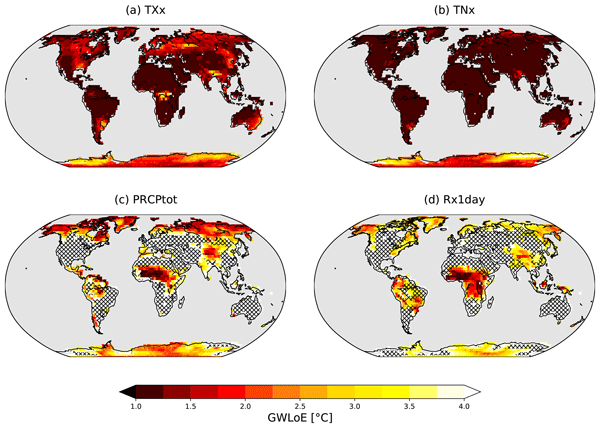
Using a special suite of climate simulations, we determine if and when climate change is detectable and translate this to the global warming prevalent in the corresponding year. Our results show that, at 1.5°C warming, >85 % of the global population (>95 % at 2.0° warming) is already exposed to nighttime temperatures altered by climate change beyond natural variability. Furthermore, even incremental changes in global warming levels result in increased human exposure to emerged climate signals.
Julia Miller, Andrea Böhnisch, Ralf Ludwig, and Manuela I. Brunner
Nat. Hazards Earth Syst. Sci., 24, 411–428, https://doi.org/10.5194/nhess-24-411-2024, https://doi.org/10.5194/nhess-24-411-2024, 2024
Short summary
Short summary
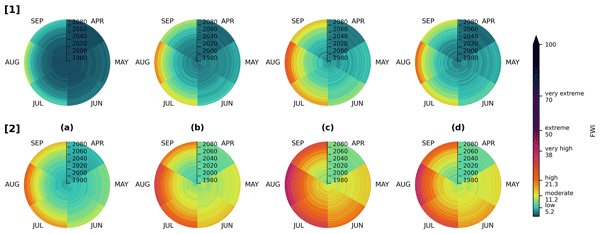
We assess the impacts of climate change on fire danger for 1980–2099 in different landscapes of central Europe, using the Canadian Forest Fire Weather Index (FWI) as a fire danger indicator. We find that today's 100-year FWI event will occur every 30 years by 2050 and every 10 years by 2099. High fire danger (FWI > 21.3) becomes the mean condition by 2099 under an RCP8.5 scenario. This study highlights the potential for severe fire events in central Europe from a meteorological perspective.
Benjamin Poschlod, Laura Sailer, Alexander Sasse, Anastasia Vogelbacher, and Ralf Ludwig
EGUsphere, https://doi.org/10.5194/egusphere-2025-2483, https://doi.org/10.5194/egusphere-2025-2483, 2025
Short summary
Short summary
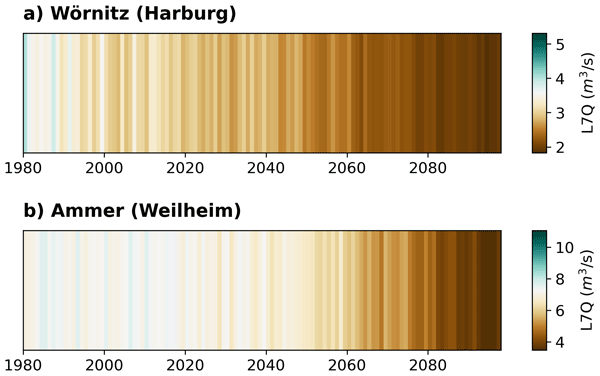
Europe was hit by severe droughts in recent years resulting in extreme low flow conditions in rivers. Here, we investigate future climate change effects on river droughts in Bavaria. We find increasing severity for the low peak discharge and low flow duration in a warmer climate. This is caused by hotter and drier summers, where the joint occurrence of heat and drought intensifies. Further, we show that conditions in the year before the drought gain more importance in a warmer climate.
Carolin Boos, Sophie Reinermann, Raul Wood, Ralf Ludwig, Anne Schucknecht, David Kraus, and Ralf Kiese
EGUsphere, https://doi.org/10.5194/egusphere-2024-2864, https://doi.org/10.5194/egusphere-2024-2864, 2024
Preprint archived
Short summary
Short summary
We applied a biogeochemical model on grasslands in the pre-Alpine Ammer region in Germany and analyzed the influence of soil and climate on annual yields. In drought affected years, total yields were decreased by 4 %. Overall, yields decrease with rising elevation, but less so in drier and hotter years, whereas soil organic carbon has a positive impact on yields, especially in drier years. Our findings imply, that adapted management in the region allows to mitigate yield losses from drought.
Florian Willkofer, Raul R. Wood, and Ralf Ludwig
Hydrol. Earth Syst. Sci., 28, 2969–2989, https://doi.org/10.5194/hess-28-2969-2024, https://doi.org/10.5194/hess-28-2969-2024, 2024
Short summary
Short summary
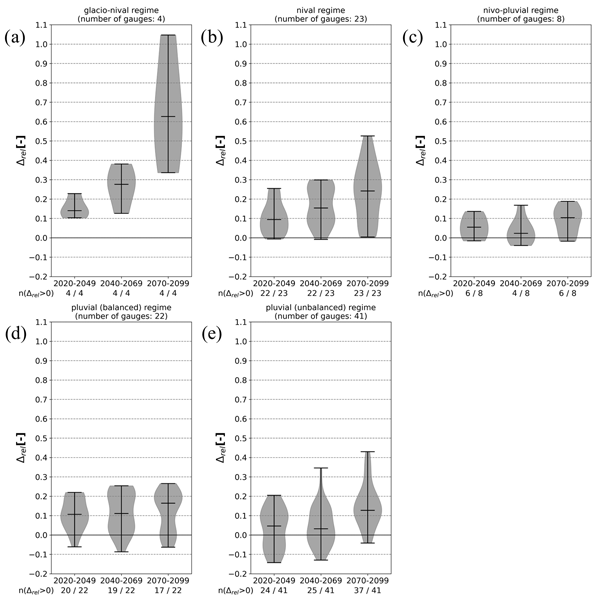
Severe flood events pose a threat to riverine areas, yet robust estimates of the dynamics of these events in the future due to climate change are rarely available. Hence, this study uses data from a regional climate model, SMILE, to drive a high-resolution hydrological model for 98 catchments of hydrological Bavaria and exploits the large database to derive robust values for the 100-year flood events. Results indicate an increase in frequency and intensity for most catchments in the future.
David Gampe, Clemens Schwingshackl, Andrea Böhnisch, Magdalena Mittermeier, Marit Sandstad, and Raul R. Wood
Earth Syst. Dynam., 15, 589–605, https://doi.org/10.5194/esd-15-589-2024, https://doi.org/10.5194/esd-15-589-2024, 2024
Short summary
Short summary
Using a special suite of climate simulations, we determine if and when climate change is detectable and translate this to the global warming prevalent in the corresponding year. Our results show that, at 1.5°C warming, >85 % of the global population (>95 % at 2.0° warming) is already exposed to nighttime temperatures altered by climate change beyond natural variability. Furthermore, even incremental changes in global warming levels result in increased human exposure to emerged climate signals.
Julia Miller, Andrea Böhnisch, Ralf Ludwig, and Manuela I. Brunner
Nat. Hazards Earth Syst. Sci., 24, 411–428, https://doi.org/10.5194/nhess-24-411-2024, https://doi.org/10.5194/nhess-24-411-2024, 2024
Short summary
Short summary
We assess the impacts of climate change on fire danger for 1980–2099 in different landscapes of central Europe, using the Canadian Forest Fire Weather Index (FWI) as a fire danger indicator. We find that today's 100-year FWI event will occur every 30 years by 2050 and every 10 years by 2099. High fire danger (FWI > 21.3) becomes the mean condition by 2099 under an RCP8.5 scenario. This study highlights the potential for severe fire events in central Europe from a meteorological perspective.
Elizaveta Felsche and Ralf Ludwig
Nat. Hazards Earth Syst. Sci., 21, 3679–3691, https://doi.org/10.5194/nhess-21-3679-2021, https://doi.org/10.5194/nhess-21-3679-2021, 2021
Short summary
Short summary
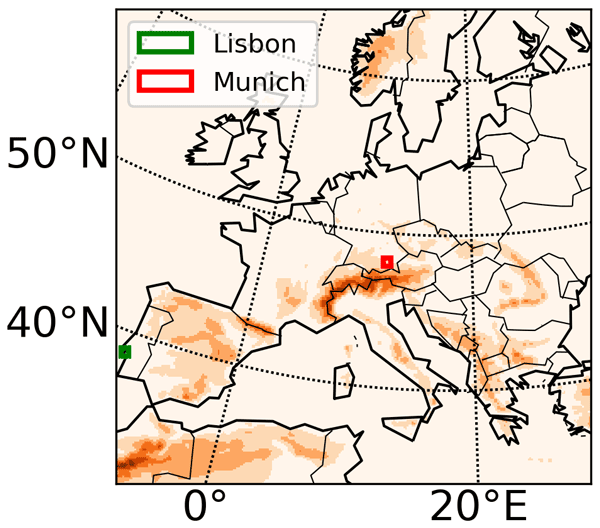
This study applies artificial neural networks to predict drought occurrence in Munich and Lisbon, with a lead time of 1 month. An analysis of the variables that have the highest impact on the prediction is performed. The study shows that the North Atlantic Oscillation index and air pressure 1 month before the event have the highest importance for the prediction. Moreover, it shows that seasonality strongly influences the goodness of prediction for the Lisbon domain.
Nicola Maher, Sebastian Milinski, and Ralf Ludwig
Earth Syst. Dynam., 12, 401–418, https://doi.org/10.5194/esd-12-401-2021, https://doi.org/10.5194/esd-12-401-2021, 2021
Benjamin Poschlod, Ralf Ludwig, and Jana Sillmann
Earth Syst. Sci. Data, 13, 983–1003, https://doi.org/10.5194/essd-13-983-2021, https://doi.org/10.5194/essd-13-983-2021, 2021
Short summary
Short summary
This study provides a homogeneous data set of 10-year rainfall return levels based on 50 simulations of the Canadian Regional Climate Model v5 (CRCM5). In order to evaluate its quality, the return levels are compared to those of observation-based rainfall of 16 European countries from 32 different sources. The CRCM5 is able to capture the general spatial pattern of observed extreme precipitation, and also the intensity is reproduced in 77 % of the area for rainfall durations of 3 h and longer.
Cited articles
an der Heiden, M.: Neubestimmung der Prädiktionsintervalle zur Schätzung der hitze-bedingten Mortalität – Kommentar und Erläuterung zu “Hitzebedingte Mortalität in Deutschland” (Epidemiologisches Bulletin 42/2022), Epid. Bull., 26, 14–16 https://doi.org/10.25646/11580, 2023.
Bayerisches Landesamt für Umwelt (LfU): Sturzfluten und Hochwasserereignisse Mai/Juni 2016, https://files.hnd.bayern.de/berichte/lfu_SturzflutenMaiJuni2016.pdf (last access: 20 January 2026), 2017.
Bayerisches Landesamt für Umwelt (LfU): Bayerisches Klimainformationssystem, https://klimainformationssystem.bayern.de/ (last access: 20 January 2026), 2024.
Bayerisches Landesamt für Umwelt (LfU): Die Klimafaktenblätter des LfU, https://www.lfu.bayern.de/klima/klimawandel/klimafaktenblaetter/index.htm, last access: 20 January 2026.
Bayerisches Staatsministerium für Wirtschaft, Landesentwicklung und Energie (StMWi): Naturgefahren in Bayern, https://www.stmwi.bayern.de/wirtschaft/elementarschadenversicherung/naturgefahren-in-bayern/ (last access: 20 January 2026), 2025.
Böhnisch, A., Mittermeier, M., Leduc, M., and Ludwig, R.: Hot spots and climate trends of meteorological droughts in Europe: assessing the percent of normal index in a single-model initial condition large ensemble, Frontiers in Water, 3, https://doi.org/10.3389/frwa.2021.716621, 2021.
Böhnisch, A., Felsche, E., Mittermeier, M., Poschlod, B., and Ludwig, R.: Future Patterns of Compound Dry and Hot Summers and Their Link to Soil Moisture Droughts in Europe, Earth's Future, 13, https://doi.org/10.1029/2024EF004916, 2025.
Bojovic, D., St. Clair, A. L., Christel, I., Terrado, M., Stanzel, P., Gonzalez, P., and Palin, E. J.: Engagement, involvement and empowerment: Three realms of a coproduction framework for climate services, Global Environmental Change, 68, 102271, https://doi.org/10.1016/j.gloenvcha.2021.102271, 2021.
Bundesgesetzblatt (BGBl.): Bundes-Klimaanpassungsgesetz (KAnG), Bundesgesetzblatt Nr. 393, https://www.recht.bund.de/bgbl/1/2023/393/VO (last access: 20 January 2026), 2023.
Climate Service Center Germany (GERICS): Fact-Sheets, https://www.gerics.de/products_and_publications/fact_sheets/index.php.de, last access: 20 January 2026.
Cruz-Pérez, N., Rodríguez-Alcántara, J. S., Rodríguez-Martín, J., Moujan, C., La Jeunesse, I., and Santamarta, J. C.: Living labs as participatory and community learning applied to regional development, in: Proceedings of EDULEARN23 Conference 3–5 July 2023, Palma, Mallorca, Spain, https://doi.org/10.21125/EDULEARN.2023.1707 2023.
European Centre for Medium-Range Weather Forecasts (ECMWF): Copernicus Climate Change Services, https://climate.copernicus.eu, last access: 20 January 2026.
European Environment Agency (EEA): CORINE land cover 2018 (raster), Europe, 6 yearly, European Environment Agency (EEA) [data set], https://doi.org/10.2909/960998c1-1870-4e82-8051-6485205ebbac, 2020.
Findlater, K., Webber, S., Kandlikar, M., and Donner, S.: Climate services promise better decisions but mainly focus on better data, Nature Climate Change, 11, 731–737, https://doi.org/10.1038/s41558-021-01125-3, 2021.
Jacobs, K. and Street, R.: The next generation of climate services, Climate Services, 20, https://doi.org/10.1016/j.cliser.2020.100199, 2020.
Koutroulis, A. G., Grillakis, M. G., Tsanis, I. K., and Jacob, D.: Exploring the ability of current climate information to facilitate local climate services for the water sector, Earth Perspectives 2, 6, https://doi.org/10.1186/s40322-015-0032-5, 2015.
Leach, N. J., Li, S., Sparrow, S., van Oldenborgh, G. J., Lott, F. C., Weisheimer, A., and Allen, M. R.: Anthropogenic Influence on the 2018 Summer Warm Spell in Europe: The Impact of Different Spatio-Temporal Scales, B. Am. Meteorol. Soc., 101, S41–S46, https://doi.org/10.1175/BAMS-D-19-0201.1, 2020.
Miller, J., Böhnisch, A., Ludwig, R., and Brunner, M. I.: Climate change impacts on regional fire weather in heterogeneous landscapes of central Europe, Nat. Hazards Earth Syst. Sci., 24, 411–428, https://doi.org/10.5194/nhess-24-411-2024, 2024.
Moujan, C., La Jeunesse, I., Akinsete, E., and Guittard, A.: Reframing Transition Pathways and Values Through System Innovation Across 9 European Regions, in: Proceedings of the OpenLivingLab Days Conference 2023, edited by: European Networks of Living Labs, OpenLivingLabDays 2023 (OLLD), Zenodo [conference proceeding], https://doi.org/10.5281/zenodo.10948803, 2023.
Mulgan, G. and Leadbeater, C.: Systems Innovation, Nesta, London, https://media.nesta.org.uk/documents/systems_innovation_discussion_paper.pdf (last access: 20 January 2026), 2013.
Munich RE: Severe thunderstorms and flooding drive natural disaster losses in the first half of 2024 https://www.munichre.com/en/company/media-relations/media-information-and-corporate-news/media-information/2024/natural-disaster-figures-first-half-2024.html (last access: 20 January 2026), 2024.
Raaphorst, K., Koers, G., Ellen, G. J., Oen, A., Kalsnes, B., van Well, L., Koerth, J., and van der Brugge, R.: Mind the Gap: Towards a Typology of Climate Service Usability Gaps, Sustainability, 12, 1512, https://doi.org/10.3390/su12041512, 2020.
Schröter, J., Knauf, J., Tivig, M., Lorenz, P., Sauerbrei, R., and Kreienkamp, F.: Attributionsstudie zu den Niederschlagsereignissen in Bayern und Baden-Württemberg Mai–Juni 2024, Bericht des Deutschen Wetterdienstes, https://doi.org/10.5676/dwd_pub/attribution/2024_02, 2024.
Sodoge, J., Kuhlicke, C., Mahecha, M. D., and de Brito, M. M.: Text mining uncovers the unique dynamics of socio-economic impacts of the 2018–2022 multi-year drought in Germany, Nat. Hazards Earth Syst. Sci., 24, 1757–1777, https://doi.org/10.5194/nhess-24-1757-2024, 2024.
Statistisches Bundesamt (Destatis): Wassergewinnung, Einwohner mit Anschluss an die öffentliche Wasserversorgung, Wasserabgabe: Bundesländer, Jahre 2007–2022 (Code: 32211-0001), Statistisches Bundesamt [data set], https://www-genesis.destatis.de/datenbank/online/url/86e73ef4 (last access: 20 January 2026), 2025.
Swart, R., Celliers, L., Collard, M., Prats, A. G., Huang-Lachmann, J.-T., Sempere, F. L., de Jong, F., Máñez Costa, M., Martinez, G., Velazquez, M. P., Martín, A., Segretier, W., Stattner, E., and Timmermans, W.: Reframing climate services to support municipal and regional planning, Climate Services, 22, 100227, https://doi.org/10.1016/j.cliser.2021.100227, 2021.
Street, R. B.: Towards a leading role on climate services in Europe: A research and innovation roadmap, Climate Services, 1, 2–5, https://doi.org/10.1016/j.cliser.2015.12.001, 2016.
Tradowsky, J. S., Philip, S. Y., Kreienkamp, F., Kew, S. F., Lorenz, P., Arrighi, J., Bettmann, T., Caluwaerts, S., Chan, S. C., De Cruz, L., de Vries, H., Demuth, N., Ferrone, A., Fischer, E. M., Fowler, H. J., Goergen, K., Heinrich, D., Henrichs, Y., Kaspar, F., Lenderink, G., Nilson, E., Otto, F. E. L., Ragone, F., Seneviratne, S. I., Singh, R. K., Skålevåg, A., Termonia, P., Thalheimer, L., van Aalst, M., Van den Bergh, J., Van de Vyver, H., Vannitsem, S., van Oldenborgh, G. J., Van Schaeybroeck, B., Vautard, R., Vonk, D., and Wanders, N.: Attribution of the heavy rainfall events leading to severe flooding in Western Europe during July 2021, Climatic Change, 176, 90, https://doi.org/10.1007/s10584-023-03502-7, 2023.
Vogel, M. M., Zscheischler, J., Wartenburger, R., Dee, D., and Seneviratne, S. I.: Concurrent 2018 hot extremes across Northern Hemisphere due to human-induced climate change, Earth's Future, 7, 692–703, https://doi.org/10.1029/2019EF001189, 2019.
Weaver, C. P., Lempert, R. J., Brown, C., Hall, J. A., Revell, D., and Sarewitz, D.: Improving the contribution of climate model information to decision making: the value and demands of robust decision frameworks, WIREs Clim. Change, 4, 39–60, https://doi.org/10.1002/wcc.202, 2013.
Willkofer, F., Wood, R. R., and Ludwig, R.: Assessing the impact of climate change on high return levels of peak flows in Bavaria applying the CRCM5 large ensemble, Hydrol. Earth Syst. Sci., 28, 2969–2989, https://doi.org/10.5194/hess-28-2969-2024, 2024.
Short summary
Climate services comprise of climate model or observational data that is provided by scientists or authorities to stakeholders who use them in decision-making processes. However, providers and users typically have diverging expectations regarding the data. We here describe various aspects of the gap between needs and offers that were identified in two workshops in the Main River catchment (central Germany). To bridge the gap, we propose a framework that can guide future stakeholder dialogues.
Climate services comprise of climate model or observational data that is provided by scientists...