

11 May 2026
| 11 May 2026
The regional reanalysis COSMO-R6G2 as a successor to COSMO-REA6: evaluation for renewable energy applications
Deutscher Wetterdienst, Climate and Environment, Frankfurter Straße 135, 63067 Offenbach, Germany
Fraunhofer Institute for Energy Economics and Energy System Technology (Fraunhofer IEE), Joseph-Beuys-Str. 8, 34117 Kassel, Germany
Michael Borsche
Deutscher Wetterdienst, Climate and Environment, Frankfurter Straße 135, 63067 Offenbach, Germany
Frank Kaspar
Deutscher Wetterdienst, Climate and Environment, Frankfurter Straße 135, 63067 Offenbach, Germany
now at: EUMETSAT, Darmstadt, Germany
Thomas Spangehl
Deutscher Wetterdienst, Climate and Environment, Frankfurter Straße 135, 63067 Offenbach, Germany
Dehong Yuan
Department of Sustainable Electrical Energy Systems, University of Kassel, Wilhelmshöher Allee 73, 34121 Kassel, Germany
Fraunhofer Institute for Energy Economics and Energy System Technology (Fraunhofer IEE), Joseph-Beuys-Str. 8, 34117 Kassel, Germany
David Geiger
Department of Sustainable Electrical Energy Systems, University of Kassel, Wilhelmshöher Allee 73, 34121 Kassel, Germany
Fraunhofer Institute for Energy Economics and Energy System Technology (Fraunhofer IEE), Joseph-Beuys-Str. 8, 34117 Kassel, Germany
Lukas Pauscher
Department of Sustainable Electrical Energy Systems, University of Kassel, Wilhelmshöher Allee 73, 34121 Kassel, Germany
Fraunhofer Institute for Energy Economics and Energy System Technology (Fraunhofer IEE), Joseph-Beuys-Str. 8, 34117 Kassel, Germany
Acoustics and Vibrations Research Group (AVRG), Vrije Universiteit Brussel, Pleinlaan 2, Ixelles, Brussels, 1050, Belgium
Related authors
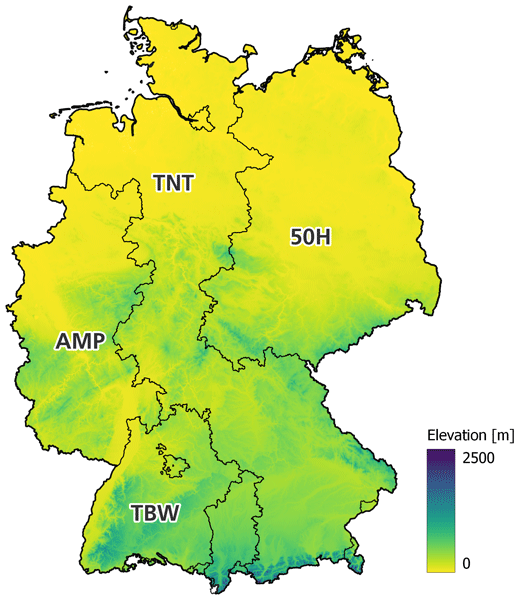
David Geiger, Christoph Zink, Franziska Bär, Maximilian Pfennig, Doron Callies, Carsten Pape, Jaqueline Drücke, and Lukas Pauscher
Adv. Sci. Res., 22, 131–148, https://doi.org/10.5194/asr-22-131-2026, https://doi.org/10.5194/asr-22-131-2026, 2026
Short summary
Short summary
In this paper we analyse the suitability of different reanalyses and meso-scale models for simulating wind energy in Germany. We found that all datasets overestimate energy production, with errors ranging from 5 % to 45 %. This suggests that the underlying models may not accurately reflect average wind conditions. CERRA and ERA5 performed the best, but they also require regional adjustment. Understanding the cause of these differences is crucial for improving weather and wind energy modelling.
Andreas Hense, Christoph Kottmeier, Petra Friederichs, Sebastian Buschow, Svenja Szemkus, Uwe Ulbrich, Jens Grieger, Joaquim G. Pinto, Hendrik Feldmann, Frank Kaspar, Deborah Niermann, Rike Lorenz, Florian Ruff, and Etor E. Lucio Eceiza
EGUsphere, https://doi.org/10.5194/egusphere-2026-2697, https://doi.org/10.5194/egusphere-2026-2697, 2026
This preprint is open for discussion and under review for Natural Hazards and Earth System Sciences (NHESS).
Short summary
Short summary
The extreme events heatwaves, droughts, heavy precipitation, floods and wind storms affect socio-economic systems and generate strong public attention. They are embedded into atmospheric dynamics and are statistically rare events. Here we compile the contributions of twenty one articles of the inter-journal NHESS/ASCMO/WCD special issue by project ClimXtreme parallel to results from thirty three more publication. The conclusions underline the complexity of the results.
David Geiger, Christoph Zink, Franziska Bär, Maximilian Pfennig, Doron Callies, Carsten Pape, Jaqueline Drücke, and Lukas Pauscher
Adv. Sci. Res., 22, 131–148, https://doi.org/10.5194/asr-22-131-2026, https://doi.org/10.5194/asr-22-131-2026, 2026
Short summary
Short summary
In this paper we analyse the suitability of different reanalyses and meso-scale models for simulating wind energy in Germany. We found that all datasets overestimate energy production, with errors ranging from 5 % to 45 %. This suggests that the underlying models may not accurately reflect average wind conditions. CERRA and ERA5 performed the best, but they also require regional adjustment. Understanding the cause of these differences is crucial for improving weather and wind energy modelling.
Kira Gramitzky, Florian Jäger, Doron Callies, Tabea Hildebrand, Julie K. Lundquist, and Lukas Pauscher
Wind Energ. Sci., 11, 861–882, https://doi.org/10.5194/wes-11-861-2026, https://doi.org/10.5194/wes-11-861-2026, 2026
Short summary
Short summary
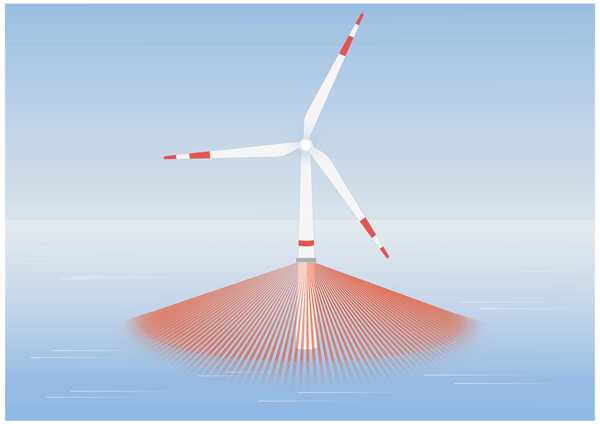
This study introduces an extended sea surface levelling method for the accurate offshore calibration of scanning lidars. This method can determine the alignment of the laser beam, including any vertical shift, and is independent of the scan pattern. Tests using real measurement data and a detailed uncertainty study confirm its reliability. The study offers a versatile calibration approach and improves confidence in offshore wind measurements with scanning lidars.
Angelika Palarz, Thomas Junghänel, Jennifer Ostermöller, Thomas Deutschländer, and Frank Kaspar
EGUsphere, https://doi.org/10.5194/egusphere-2026-1067, https://doi.org/10.5194/egusphere-2026-1067, 2026
Short summary
Short summary
This study assesses heavy precipitation events (HPEs) across Germany using recently digitised and quality-controlled 5-min precipitation data. The analysis of HPEs with durations ranging from 5 minutes to 7 days reveal a pronounced duration dependence. Short-duration HPEs show predominantly positive tendencies and increasing intensities, whereas long-duration HPEs display more balanced or locally slightly decreasing intensities in recent decades.
Johannes Meuer, Laurens M. Bouwer, Frank Kaspar, Roman Lehmann, Wolfgang Karl, Thomas Ludwig, and Christopher Kadow
Hydrol. Earth Syst. Sci., 29, 3687–3701, https://doi.org/10.5194/hess-29-3687-2025, https://doi.org/10.5194/hess-29-3687-2025, 2025
Short summary
Short summary
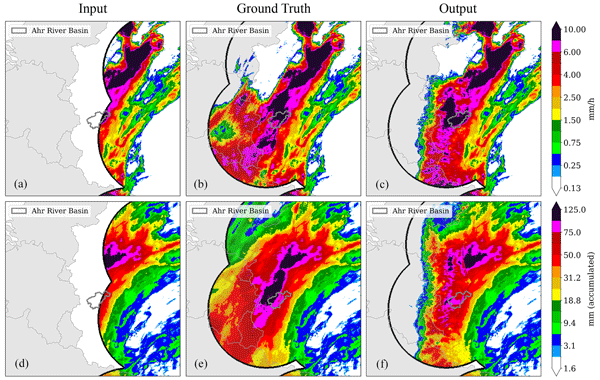
Our study focuses on filling in missing precipitation data using an advanced neural network model. Traditional methods for estimating missing climate information often struggle in large regions where data are scarce. Our solution, which incorporates recent advances in machine learning, captures the intricate patterns of precipitation over time, especially during extreme weather events. Our model shows good performance in reconstructing large regions of missing rainfall radar data.
Abhay Devasthale, Sandra Andersson, Erik Engström, Frank Kaspar, Jörg Trentmann, Anke Duguay-Tetzlaff, Jan Fokke Meirink, Erik Kjellström, Tomas Landelius, Manu Anna Thomas, and Karl-Göran Karlsson
Earth Syst. Dynam., 16, 1169–1182, https://doi.org/10.5194/esd-16-1169-2025, https://doi.org/10.5194/esd-16-1169-2025, 2025
Short summary
Short summary
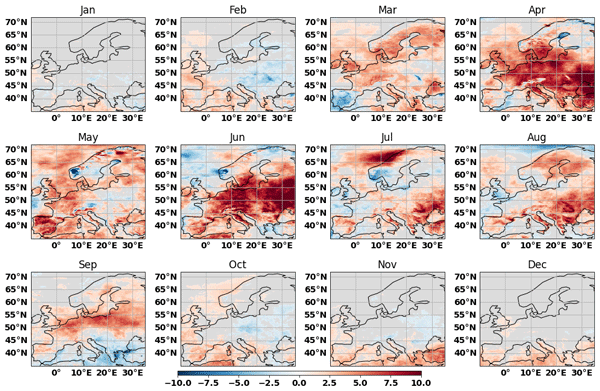
By compositing trends in multiple climate variables, this study presents emerging regimes that are relevant for solar energy applications. It is shown that the favourable conditions for exploiting solar energy are emerging during spring and early summer. The study also underscores the increasingly important role of clouds in regulating surface solar radiation as the aerosol concentrations are decreasing over Europe and the societal value of satellite-based climate monitoring.
Thomas Spangehl, Michael Borsche, Deborah Niermann, Frank Kaspar, Semjon Schimanke, Susanne Brienen, Thomas Möller, and Maren Brast
Adv. Sci. Res., 20, 109–128, https://doi.org/10.5194/asr-20-109-2023, https://doi.org/10.5194/asr-20-109-2023, 2023
Short summary
Short summary
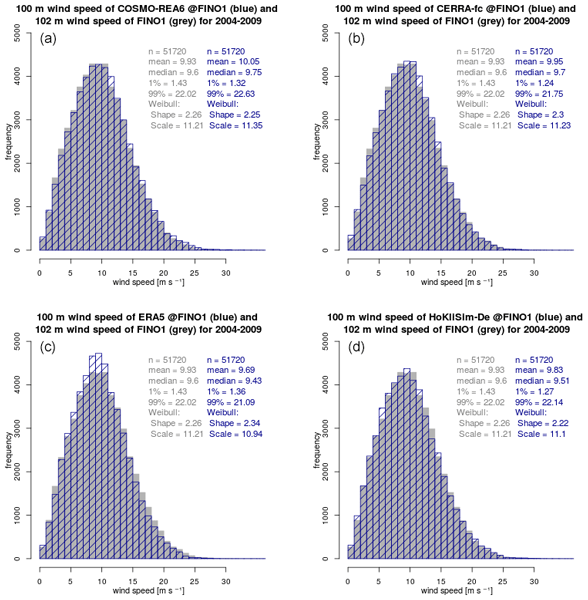
The quality of the global reanalysis ERA5, the regional reanalysis COSMO-REA6 and a successor version (R6G2), the new Copernicus European Regional Re-Analysis (CERRA) and a regional downscaling simulation with COSMO-CLM (HoKliSim-De) is assessed for offshore wind farm planning in the German Exclusive Economic Zone (EEZ) of the North Sea. The quality is assessed using in-situ wind measurements at the research platform FINO1 and satellite-based data of the near-surface wind speed as reference.

Katharina Lengfeld, Paul Voit, Frank Kaspar, and Maik Heistermann
Nat. Hazards Earth Syst. Sci., 23, 1227–1232, https://doi.org/10.5194/nhess-23-1227-2023, https://doi.org/10.5194/nhess-23-1227-2023, 2023
Short summary
Short summary
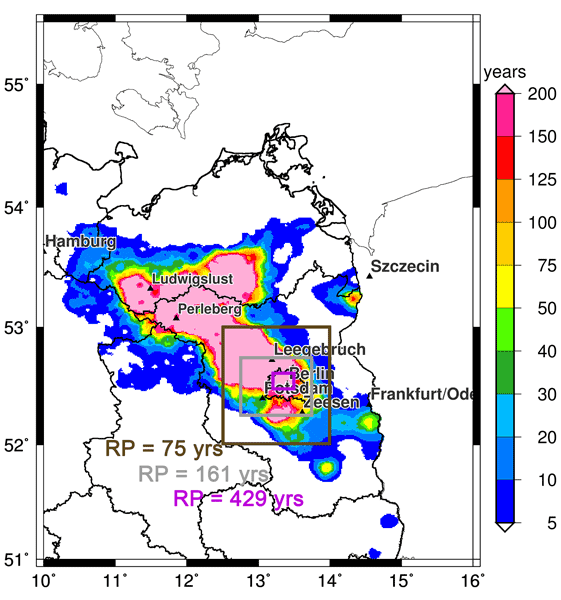
Estimating the severity of a rainfall event based on the damage caused is easy but highly depends on the affected region. A less biased measure for the extremeness of an event is its rarity combined with its spatial extent. In this brief communication, we investigate the sensitivity of such measures to the underlying dataset and highlight the importance of considering multiple spatial and temporal scales using the devastating rainfall event in July 2021 in central Europe as an example.
Alberto Caldas-Alvarez, Markus Augenstein, Georgy Ayzel, Klemens Barfus, Ribu Cherian, Lisa Dillenardt, Felix Fauer, Hendrik Feldmann, Maik Heistermann, Alexia Karwat, Frank Kaspar, Heidi Kreibich, Etor Emanuel Lucio-Eceiza, Edmund P. Meredith, Susanna Mohr, Deborah Niermann, Stephan Pfahl, Florian Ruff, Henning W. Rust, Lukas Schoppa, Thomas Schwitalla, Stella Steidl, Annegret H. Thieken, Jordis S. Tradowsky, Volker Wulfmeyer, and Johannes Quaas
Nat. Hazards Earth Syst. Sci., 22, 3701–3724, https://doi.org/10.5194/nhess-22-3701-2022, https://doi.org/10.5194/nhess-22-3701-2022, 2022
Short summary
Short summary
In a warming climate, extreme precipitation events are becoming more frequent. To advance our knowledge on such phenomena, we present a multidisciplinary analysis of a selected case study that took place on 29 June 2017 in the Berlin metropolitan area. Our analysis provides evidence of the extremeness of the case from the atmospheric and the impacts perspectives as well as new insights on the physical mechanisms of the event at the meteorological and climate scales.
Philip Gauglitz, David Geiger, Jan Ulffers, and Evamaria Zauner
Adv. Geosci., 56, 1–12, https://doi.org/10.5194/adgeo-56-1-2021, https://doi.org/10.5194/adgeo-56-1-2021, 2021
Short summary
Short summary
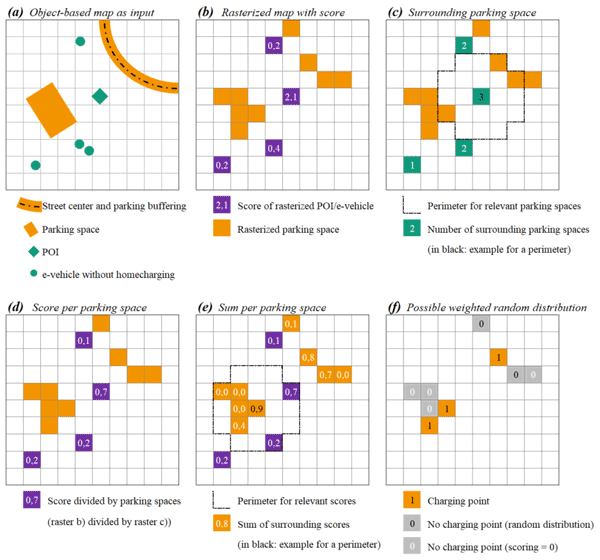
We model two kinds of demand for public charging infrastructure: As compensation for the lack of home charging points, and based on points of interest. We combine those two demands with the available parking spaces and generate distributions for possible future charging points. We use a raster-based approach on a municipality’s full grid. The model is compared with three other models in a correlation comparison in order to determine the influence of certain model assumptions and input data.
Cited articles
Bär, F., Kaspar, F., Streek, P., Gersdorf, F., Auerbach, M., and Rieck, D.: Abschätzung des potenziellen jährlichen Energieertrags von PV-Anlagen an Lärmschutzeinrichtungen der Verkehrswege, BMDV-Expertennetzwerk, Technical Report, 2022.
Basse, A., Pauscher, L., and Callies, D.: Improving Vertical Wind Speed Extrapolation Using Short-Term Lidar Measurements, Remote Sens., 12, 1091, https://doi.org/10.3390/rs12071091, 2020.
Basse, A., Callies, D., Grötzner, A., and Pauscher, L.: Seasonal effects in the long-term correction of short-term wind measurements using reanalysis data, Wind Energ. Sci., 6, 1473–1490, https://doi.org/10.5194/wes-6-1473-2021, 2021.
Behrens, K. and Grewe, R.: A comparison of SCAPP radiation data with global, diffuse and direct solar radiation, in: WMO Technical Conference on Meteorological and Environmental Instruments and Methods of Observation (TECO-2005), vol. 1265, World Meteorological Organization, https://library.wmo.int/idurl/4/41919, 2005.
Beyrich, F. and Adam, W. K.: Site and Data Report for the Lindenberg Reference Site in CEOP – Phase I, Berichte des Deutschen Wetterdienstes, 230, Offenbach am Main, Germany, 55 pp., ISBN 978-3-88148-422-0, 2007.
Bollmeyer, C., Keller, J. D., Ohlwein, C., Wahl, S., Crewell, S., Friederichs, P., Hense, A., Keune, J., Kneifel, J. Pscheidt, I., Redle, S., and Steinke, S.: Towards a high-resolution regional reanalysis for the European CORDEX domain, Q. J. Roy. Meteor. Soc., 141, 1–15, https://doi.org/10.1002/qj.2486, 2015.
Bollmeyer, C., Keller, J., Ohlwein, C., Hense, A., Borsche, M., Niermann, D., Kaspar, F., and Schupfner, M.: Regional Reanalysis COSMO-REA6 – Standardised Parameters. World Data Center for Climate (WDCC) at DKRZ [data set], https://doi.org/10.26050/WDCC/CR6_EU6, 2024.
Borsche, M., Kaiser-Weiss, A. K., and Kaspar, F.: Wind speed variability between 10 and 116 m height from the regional reanalysis COSMO-REA6 compared to wind mast measurements over Northern Germany and the Netherlands, Adv. Sci. Res., 13, 151–161, https://doi.org/10.5194/asr-13-151-2016, 2016.
Brune, S., Keller, J. D., and Wahl, S.: Evaluation of wind speed estimates in reanalyses for wind energy applications, Adv. Sci. Res., 18, 115–126, https://doi.org/10.5194/asr-18-115-2021, 2021.
Bundesamt für Seeschifffahrt und Hydrographie: Forschungsplattformen in Nord- und Ostsee, FINO data, Bundesamt für Seeschifffahrt und Hydrographie [data set], https://www.bsh.de/EN/TOPICS/Monitoring_systems/MARNET_monitoring_network/FINO/fino_node.html (last access: 7 May 2026), 2024.
Dee, D. P., Uppala, S. M., Simmons, A. J., Berrisford, P., Poli, P., Kobayashi, S., Andrae, U., Balmaseda, M. A., Balsamo, G., Bauer, P., Bechtold, P., Beljaars, A. C. M., van de Berg, L., Bidlot, J., Bormann, N., Delsol, C., Dragani, R., Fuentes, M., Geer, A. J., Haimberger, L., Healy, S. B., Hersbach, H., Hólm, E. V., Isaksen, L., Kållberg, P., Köhler, M., Matricardi, M., McNally, A. P., Monge-Sanz, B. M., Morcrette, J.-J., Park, B.-K., Peubey, C., de Rosnay, P., Tavolato, C., Thépaut, J.-N., and Vitart, F.: The ERA-Interim reanalysis: Configuration and performance of the data assimilation system, Q. J. Roy. Meteor. Soc., 137, 553–597, https://doi.org/10.1002/qj.828, 2011.
Frank, C. W., Wahl, S., Keller, J. D., Pospichal, B., Hense, A., and Crewell, S.: Bias correction of a novel European reanalysis data set for solar energy applications, Solar Energy, 164, 12–24, https://doi.org/10.1016/j.solener.2018.02.012, 2018.
Geiger, D., Zink, C., Bär, F., Pfennig, M., Callies, D., Pape, C., Drücke, J., and Pauscher, L.: Assessing the performance of reanalysis and meso-scale model datasets for onshore wind power modelling in Germany, Adv. Sci. Res., 22, 131–148, https://doi.org/10.5194/asr-22-131-2026, 2026.
Heppelmann, T., Steiner, A., and Vogt, S.: Application of numerical weather prediction in wind power forecasting: Assessment of the diurnal cycle, Meteorol. Z., 26, 319–331, https://doi.org/10.1127/metz/2017/0820, 2017.
Hersbach, H., Bell, B., Berrisford, P., Hirahara, S., Horányi, A., Muñoz-Sabater, J., Nicolas, J., Peubey, C., Radu, R., Schepers, D., Simmons, A., Soci, C., Abdalla, S., Abellan, X., Balsamo, G., Bechtold, P., Biavati, G., Bidlot, J., Bonavita, M., De Chiara, G., Dahlgren, P., Dee, D., Diamantakis, M., Dragani, R., Flemming, J., Forbes, R., Fuentes, M., Geer, A., Haimberger, L., Healy, S., Hogan, R.J., Hólm, E., Janisková, M., Keeley, S., Laloyaux, P., Lopez, P., Lupu, C., Radnoti, G., De Rosnay, P., Rozum, I., Vamborg, F., Villaume, S., and Thépaut, J.-N.: The ERA5 global reanalysis, Q. J. Roy. Meteor. Soc., 146, 1999–2049, https://doi.org/10.1002/qj.3803, 2020.
IEC: 61400-50-1:2022 – Wind energy generation systems – Part 50–1: Wind measurement – Application of meteorological mast, nacelle and spinner mounted instruments, 2022a.
IEC: 61400-50-2:2022 – Wind energy generation systems – Part 50–2: Wind measurement – Application of ground-mounted remote sensing technology, 2022b.
Kaspar, F. and Mächel, H.: Beobachtung von Klima und Klimawandel in Mitteleuropa und Deutschland, in: Klimawandel in Deutschland, edited by: Brasseur, G. P., Jacob, D., and Schuck-Zöller, S., Springer Spektrum, Berlin, Heidelberg, https://doi.org/10.1007/978-3-662-66696-8_3, 2023.
Kaspar, F., Borsche, M., Pfeifroth, U., Trentmann, J., Drücke, J., and Becker, P.: A climatological assessment of balancing effects and shortfall risks of photovoltaics and wind energy in Germany and Europe, Adv. Sci. Res., 16, 119–128, https://doi.org/10.5194/asr-16-119-2019, 2019.
Kaspar, F., Niermann, D., Borsche, M., Fiedler, S., Keller, J., Potthast, R., Rösch, T., Spangehl, T., and Tinz, B.: Regional atmospheric reanalysis activities at Deutscher Wetterdienst: review of evaluation results and application examples with a focus on renewable energy, Adv. Sci. Res., 17, 115–128, https://doi.org/10.5194/asr-17-115-2020, 2020.
Kaspar, F., Bär, F., Borsche, M., Brinckmann, S., Drücke, J., Kuhl, E., Mikalsen, A. C., Möller, T., Ostermöller, J., Paxian, A., Schmidt, S., Spangehl, T., Trentmann, J., Valmassoi, A., Wandel, J., and Weber, H.: Climate Services in Support of the German Energy Transition: Examples that make a difference, J. Eur. Meteorol. Soc., 4, 100036, https://doi.org/10.1016/j.jemets.2026.100036, 2026.
Kenny, D. and Fiedler, S.: Which gridded irradiance data is best for modelling photovoltaic power production in Germany?, Solar Energy, 232, 444–458, https://doi.org/10.1016/j.solener.2021.12.044, 2022.
Kohler, M., Metzger, J., and Kalthoff, N.: Trends in temperature and wind speed from 40 years of observations at a 200-m high meteorological tower in Southwest Germany, Int. J. Climatol., 38, 23–34, 2018.
Kühn, P., Basse, A., Callies, D., Chen, Y., Döpfer, R., Freier, J., Griesbach, T., Klaas, T., and Pauscher, L.: “NEWA Forested Hill Experiment Kassel.” Fraunhofer IEE, Zenodo [data set], https://doi.org/10.5281/zenodo.3581412, 2018.
Pauscher, L., Callies, D., Klaas, T., and Foken, T.: Wind observations from a forested hill: Relating turbulence statistics to surface characteristics in hilly and patchy terrain, Meteorol. Z., 27, 43–57, https://doi.org/10.1127/metz/2017/0863, 2018.
Pfeifroth, U., Kothe, S., Müller, R., Trentmann, J., Hollmann, R., Fuchs, P., and Werscheck, M.: Surface Radiation Data Set – Heliosat (SARAH) – Edition 2, Satellite Application Facility on Climate Monitoring [data set], https://doi.org/10.5676/EUM_SAF_CM/SARAH/V002, 2017.
Pfeifroth, U., Trentmann, J., Hollmann, R., Selbach, N., Werscheck, M., and Meirink, J. F.: ICDR SEVIRI Radiation – based on SARAH-2 methods, Satellite Application Facility on Climate Monitoring [data set], https://wui.cmsaf.eu/safira/action/viewICDRDetails?acronym=SARAH_V002_ICDR (last access: 7 May 2026), 2018.
Pfeifroth, U., Kothe, S., Drücke, J., Trentmann, J., Schröder, M., Selbach, N., and Hollmann, R.: Surface Radiation Data Set – Heliosat (SARAH) – Edition 3, Satellite Application Facility on Climate Monitoring [data set], https://doi.org/10.5676/EUM_SAF_CM/SARAH/V003, 2023a.
Pfeifroth, U., Trentmann, J., and Drücke, J.: Validation Report: Meteosat Solar Surface Radiation and Effective Cloud Albedo Climate Data Records. SARAH-3, Satellite Application Facility on Climate Monitoring, is part of https://doi.org/10.5676/EUM_SAF_CM/SARAH/V003, 2023b.
Pfenninger, S. and Staffell, I.: Long-term patterns of European PV output using 30 years of validated hourly reanalysis and satellite data, Energy, 114, 1251–1265, https://doi.org/10.1016/j.energy.2016.08.060, 2016.
Rausch, T., Schuchard, M., Cañadillas, B., and Lampert, A.: One year measurements of vertical profiles of wind speed and wind direction from 40 to 500 m at Heligoland, German Bight, North Sea, Germany, Technische Universität Braunschweig, PANGAEA [data set], https://doi.org/10.1594/PANGAEA.924184, 2020.
Ritter, B. and Geleyn, J.-F.: A comprehensive radiation scheme for numerical weather prediction models with potential applications in climate simulations, Mon. Weather Rev., 120, 303–325, https://doi.org/10.1175/1520-0493(1992)120<0303:ACRSFN>2.0.CO;2, 1992.
Spangehl, T., Borsche, M., Niermann, D., Kaspar, F., Schimanke, S., Brienen, S., Möller, T., and Brast, M.: Intercomparing the quality of recent reanalyses for offshore wind farm planning in Germany's exclusive economic zone of the North Sea, Adv. Sci. Res., 20, 109–128, https://doi.org/10.5194/asr-20-109-2023, 2023.
Urraca, R., Huld, T., Martinez-de-Pison, F. J., and Sanz-Garcia, A.: Sources of uncertainty in annual global horizontal irradiance data, Solar Energy, 170, 873–884, https://doi.org/10.1016/j.solener.2018.06.005, 2018.
Valmassoi, A., Anlauf, H., Becker, A., Keller, J.D., Krebber, S., Zängl, G., Potthast, R., Cress, A., Fundel, F., Hanisch, T., Lange, M., Steinert, T., and Kaspar, F.: ICON-DREAM: ICON-dual resolution reanalysis for emulators, applications and monitoring – the ICON-dual resolution reanalysis version v1.0, Deutscher Wetterdienst [data set], https://doi.org/10.5676/dwd/icon-dream_v1, 2025.
Short summary
COSMO-REA6 is widely used in energy applications but has known deficits. Its successor, COSMO-R6G2, is evaluated for Germany, focusing on Global Horizontal Irradiance (GHI) as well as wind speed. It shows slightly lower GHI and good wind quality in flat areas, but underestimates night-time wind in mountains. Overall, it is a useful successor, though users should consider remaining limitations.
COSMO-REA6 is widely used in energy applications but has known deficits. Its successor,...


