
 | 18 Sep 2026
Building bridges across borders to co-develop flood early warning in the Sahel
Vieri Tarchiani

Daniele Ganora
Riccardo Vesipa
Francesco Pasi
Valerio Capecchi
Marco Piras
Elena Belcore
Maurizio Bacci
Tiziana Antonietta De Filippis
Maurizio Tiepolo
Flood risk in the Sahel has increased markedly over recent decades, driven by the intensification of hydro-climatic hazards and the rapid growth of exposure in urban and peri-urban areas. In this context, FEWSs (FEWSs) are increasingly recognized as a key component of climate services for disaster risk reduction, as emphasized by the United Nations Early Warnings for All initiative. However, in West Africa such systems remain limited, particularly in transboundary river basins, where institutional fragmentation, data-sharing constraints, and asymmetries in technical capacity hinder effective cooperation.
This paper analyses the transboundary expansion of the Système Local d'Alerte Précoce contre les Inondations de la Sirba (SLAPIS), initially developed in Niger and currently being extended to the shared Sirba River basin between Niger and Burkina Faso. It investigates the operational adaptations required to implement a co-production framework for flood early warning in transboundary contexts. The implementation of SLAPIS Sahel suggests that the original conceptual structure of the framework remains applicable in transboundary contexts, provided that specific implementation requirements are explicitly embedded within each co-production block. Rather than introducing additional phases, the proposed operational adaptation integrates enabling conditions and implementation tools addressing interoperability, upstream/downstream dependencies, institutional asymmetries, South-South competency development and parallel governance arrangements. The study also provides preliminary evidence that extending co-production across national borders may strengthen institutional cooperation, knowledge exchange, and service scaling, while highlighting the need for dedicated FEWS monitoring, evaluation, and learning frameworks to capture the added value of transboundary co-production processes.
- Article
(2260 KB) - Full-text XML
- BibTeX
- EndNote


Over the last decades, flood risk in the Sahel has increased sharply, with a marked rise in both the frequency and impacts of pluvial and riverine flooding (Tarhule, 2005; Aich et al., 2016; Wilcox et al., 2018; Massazza et al., 2021; Elagib et al., 2021). Multiple studies have documented a non-linear intensification of flood hazards across West Africa, driven by the combined effects of climate variability and change, land-use transformation, rapid population growth, and expanding exposure in flood-prone areas (Descroix et al., 2018; Panthou et al., 2018; Massazza et al., 2019; Chagnaud et al., 2022; Sauzedde et al., 2025; Diop et al., 2025; Tangam et al., 2025). In the central Sahel, flood events, in the last twenty years, have caused rising human losses, displacement, and severe damage to infrastructure and livelihoods (Fiorillo et al., 2018), highlighting the growing gap between hydro-climatic risk and societal preparedness (Massazza et al., 2021).
Climate services for hydro-meteorological risks have emerged as a key instrument to address this gap. By transforming climate and weather information into actionable knowledge, climate services aim to support decision-making for disaster risk reduction, adaptation, and resilience building (Vaughan and Dessai, 2014; Street, 2016; Hewitt and Stone, 2021; Born, 2021). Flood early warning systems (FEWSs) represent a core operational component of such services, integrating monitoring, forecasting, risk communication, and response capacities to enable timely and effective action (UNISDR, 2009; Street et al., 2019). Recognizing the persistent global shortfall in early warning coverage, the United Nations launched the Early Warnings for All (EW4All) initiative, with the objective of ensuring that every person on Earth is protected by multi-hazard early warning systems by 2027 (WMO, 2022). Achieving this ambition in data-scarce and institutionally fragmented regions such as the Sahel remains a major challenge. In this context, the co-production of climate services has gained increasing attention in the scientific literature. Co-production seeks to bridge the bidirectional knowledge gap between information providers and users by fostering iterative interactions, mutual learning, and shared ownership throughout the service development cycle (Vincent et al., 2018; Carter et al., 2019; Daniels et al., 2019). Rather than treating users as passive recipients of forecasts, co-production emphasizes the integration of scientific expertise with local knowledge, institutional practices, and decision contexts, thereby enhancing relevance, legitimacy, and usability (Lemos et al., 2012; Bremer et al., 2019; Daniels et al., 2019). Despite this growing body of work, most documented co-production experiences focus on national or sub-national scales (Carter et al., 2019; Vincent et al., 2021; Tarchiani and Bacci, 2024). Transboundary contexts introduce additional layers of complexity that are often underestimated. Technical services in neighbouring countries frequently operate under different mandates, capacities, data policies, and institutional cultures, leading to limited data sharing and weak operational cooperation, even when hazards affect shared river basins (Pahl-Wostl, 2019). These barriers can severely hamper the development of FEWSFEWSs in transboundary basins.
The Sirba River, a tributary of the Niger River shared between Burkina Faso (approximately 80 % of the basin area) and Niger (20 %), exemplifies these challenges. In Niger, a community-oriented FEWS has been progressively established over the past decade (Tarchiani et al., 2020), combining flood risk assessment, hydrological monitoring, forecasting, and risk communication. In contrast, the upstream portion of the basin in Burkina Faso is only sparsely monitored, and no operational FEWS exists, despite its critical role in generating downstream flood waves. This asymmetry creates both a technical and institutional gap that limits the overall performance of flood risk management along the river. Addressing this gap requires not only technological improvements, but also new forms of institutional cooperation capable of supporting joint flood risk management across national borders. Previous research based on the SLAPIS Niger experience demonstrated that co-production can successfully support the development of a nationally embedded FEWS while generating institutional, social, and operational value beyond the service itself (Tarchiani and Bacci, 2024). Building on the evidence generated by the SLAPIS Niger experience, a transboundary extension, known as SLAPIS Sahel, is currently being developed across the entire Sirba River basin (39 000 km2 shared between Burkina Faso and Niger), maintaining its community- and impact-based orientation while extending the original system with new hydraulic, hydrological, and meteorological forecasting components (Belcore et al., 2024). To date, little operational guidance is available on how to operationalize co-production across national borders where multiple sovereign institutions, asymmetric capacities, upstream–downstream dependencies, and the need to ensure interoperability between parallel institutional and decision-making systems substantially increase governance complexity.
The present study therefore investigates the operational adaptations required to operationalize co-production in a transboundary context. Rather than proposing a new conceptual framework, this study builds upon the co-production framework of Carter et al. (2019) and proposes an operational adaptation tailored to the governance and implementation challenges of transboundary FEWSs. Against this background, this paper aims to: (i) develop and test an operational adaptation of the co-production framework proposed by Carter et al. (2019) to transboundary climate services, with a specific focus on FEWSs; (ii) identify the key specificities and constraints that must be addressed when extending co-production approaches to cross-border case studies, (iii) explore the added value of co-production when applied to transboundary climate services. By grounding the analysis in the Sirba River basin, the study contributes to the emerging literature on co-production by highlighting how transboundary cooperation can be progressively transformed from a structural weakness to a strategic resource for climate-risk governance in the Sahel.
2.1 The SLAPIS Niger experience: the empirical foundation for transboundary expansion
The Système Local d'Alerte Précoce contre les Inondations de la Sirba (SLAPIS) was established in Niger under the ANADIA2 Project (2017–2020) as a community-centred FEWS. Its development and subsequent evaluation provide the empirical foundation for the transboundary adaptation presented in this study. The experience has been extensively documented in previous publications, which demonstrated both its operational effectiveness and the added value generated by the co-production process (Tarchiani et al., 2020; Tarchiani and Bacci, 2024). SLAPIS is a community-centred climate service built through sustained co-production among international data providers, national institutions, local authorities, and riverine communities. While the system integrates hydrometeorological forecasts from international partners – such as the AGRHYMET Regional Centre/SMHI and EU-JRC (Massazza et al., 2020; Passerotti et al., 2020; De Filippis et al., 2022), the design, validation, and continuous refinement of the EWS are grounded in local knowledge, community engagement, and iterative feedback loops (Fig. 1).
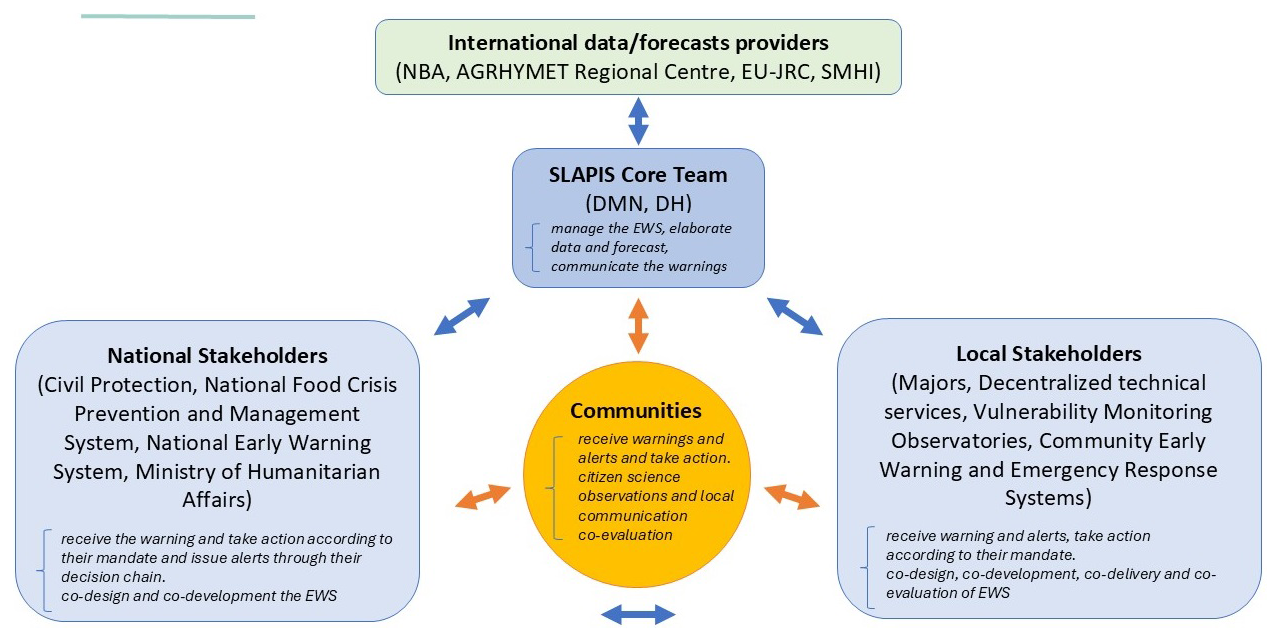
At the operational core, the SLAPIS Technical Team (National Meteorology and Hydrology Directorates) processes data, produces and communicates flood vigilance warnings. However, communities constituted an integral component of the co-production process, not only as end-users but as co-developers of the service. They contribute local knowledge that enhances risk assessment (Tiepolo et al., 2019, 2023), citizen-science observations that enhance local monitoring and improve the accuracy and contextual relevance of warnings (Tarchiani et al., 2020). Community inputs feed back into regular co-evaluation sessions, where flood forecasts, warning communication, and response protocols are jointly reviewed and adjusted (Tarchiani and Bacci, 2024).
National stakeholders (Civil Protection, the National Food Crisis Management System, the National Early Warning System, the Ministry of Humanitarian Affairs) and local authorities (mayors, decentralized technical services, vulnerability monitoring observatories, community emergency structures) engage in coordinated action based on the warnings, but they also participated in the co-design, co-delivery, and co-improvement of the EWS. This ensures that institutional procedures remain aligned with the realities, priorities, and capacities of the communities who face flood risks directly. Based on the evidence generated through the SLAPIS Niger Monitoring, Evaluation and Learning (MEL) process, a new initiative was launched in 2023 to expand the system in scope and geographical area covering the whole Sirba Basin across Burkina Faso and Niger (Fig. 2). The positive outcomes documented during the SLAPIS Niger experience provided both the empirical evidence and the institutional basis for extending the approach to the transboundary Sirba basin. The resulting initiative, SLAPIS Sahel, constitutes the empirical basis of the present study and is used here to investigate how co-production can be operationally adapted to the additional challenges posed by transboundary governance. Despite severe security constraints affecting large portions of the basin, particularly in Burkina Faso, SLAPIS Sahel, is being co-developed as part of trilateral cooperation between Italy, Niger, and Burkina Faso.
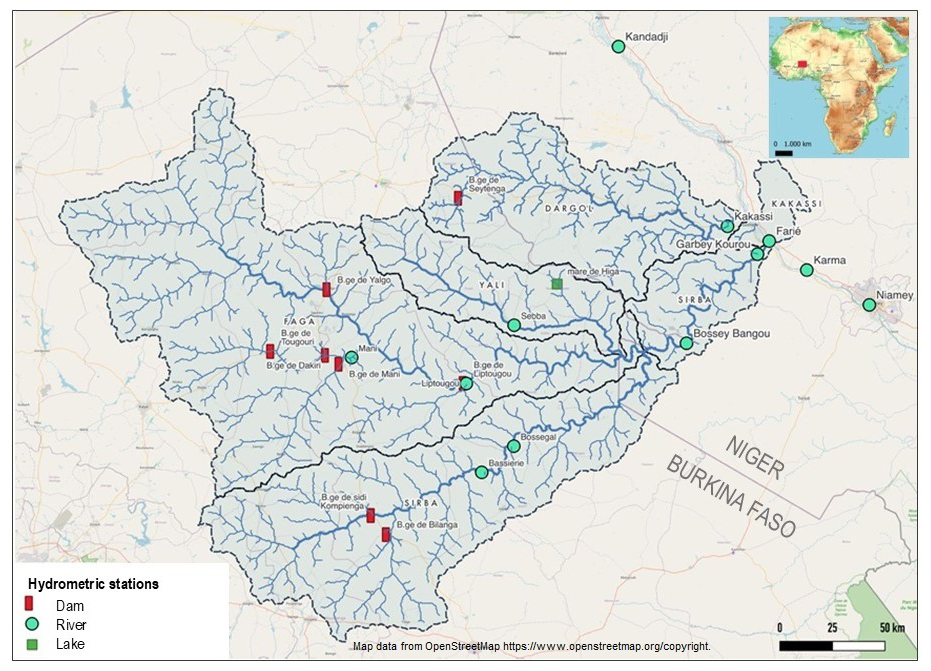
Figure 2Map of the study area.
2.2 Conceptual framework for Climate Services Co-Production
This section presents the conceptual framework within which the study is positioned. Rather than describing the operational methods applied in the Sirba River basin, it introduces the co-production framework used as an analytical lens to interpret the transboundary development of the FEWS. The operationalization and context-specific adaptations are treated as empirical and methodological results, presented in Sect. 3.
This study builds on the co-production framework proposed by Carter et al. (2019) for African weather and climate services. This framework conceptualizes co-production as an iterative process (Vincent et al., 2018) structured around six building blocks: identifying actors and building partnerships, building common ground, co-exploring needs, co-developing solutions, co-delivering services, and evaluating the process. These blocks provide a practical structure for organizing collaboration among information providers, intermediaries, users, and decision-makers (Weichselgartner and Arheimer, 2019). Within this framework, co-production is not understood as a linear transfer of information from producers to users, but as a cyclical process of interaction, mutual learning, and knowledge integration. Its purpose is to align scientific information with decision contexts, enhance usability, and strengthen trust and ownership among actors (Vincent et al., 2018; Bremer et al., 2019; Vincent et al., 2021). This process-oriented understanding is particularly relevant for climate services in data-scarce and institutionally complex contexts, where technical information must be embedded within existing decision-making systems. Although Carter et al. (2019) provide a robust structure for climate service co-production, their framework was not specifically designed for transboundary FEWSs. In such contexts, co-production must address additional challenges, including cross-border data exchange, upstream–downstream dependencies, institutional asymmetries, and the coexistence of parallel warning and decision-making chains. For this reason, the present study uses the Carter et al. (2019) framework as a conceptual starting point and examines how it can be operationally adapted to a transboundary FEWS. The adaptation itself is not treated here as an assumption, but as an empirical result emerging from the SLAPIS Sahel implementation and presented in Sect. 3.2. Finally, this study also builds on the view that the value of co-production is not limited to improved service outputs. The process itself can generate additional value by strengthening relationships, trust, shared ownership, institutional learning, and the capacity to sustain or expand services beyond an initial project cycle (Steynor et al., 2020; Visman et al., 2022; Tarchiani and Bacci, 2024).
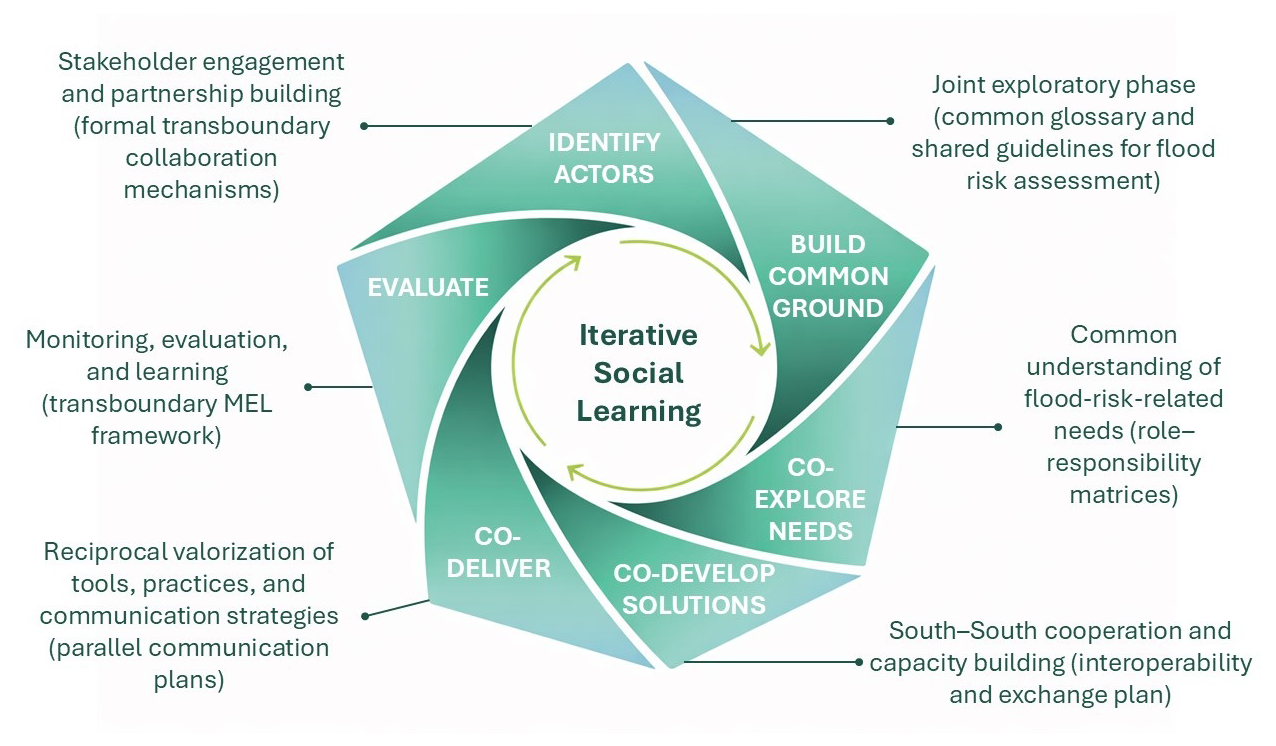
Figure 3Application of the transboundary co-production approach within SLAPIS Sahel (adapted from Tarchiani and Bacci, 2024).
3.1 Operational results of the transboundary co-production process
The implementation of the transboundary co-production process within the SLAPIS Sahel initiative generated a set of concrete institutional, organizational, and technical results (Fig. 3), while simultaneously revealing the specific challenges associated with cross-border climate service development. The following section documents how the co-production framework was translated into collaborative practices, institutional arrangements, and operational solutions, rather than evaluating the performance of the FEWS itself.
3.1.1 Identify actors and build partnership
A first operational outcome was the identification and engagement of homologous institutions in Niger, Burkina Faso (Meteorological and Hydrological Services, Civil Protection and other disaster response actors, local authorities) together with the technical counterpart institution in Italy, leading to the establishment of formal collaboration mechanisms at both national and transboundary levels. A concrete example was the signature of Memoranda of Understanding between LaMMA Tuscany Region Meteorological Service in Italy and the National Meteorological Services of Burkina Faso (ANAM) and Niger (DMN), governing the operational transfer, implementation, and long-term technical support of the regional numerical weather prediction chains. Beyond technology transfer, these agreements consolidated long-term institutional partnerships and established a common framework for operational collaboration (WMO, 2025). This process resulted in a broader and more diversified stakeholder base, including technical services, intermediaries, and end users. The diversification of involved actors significantly enriched the knowledge base and perspectives contributing to risk knowledge and assessment, fostering a more dynamic and stimulating environment for joint problem-solving and service development. At the same time, the increased number of involved institutions translated into higher coordination efforts and costs. Managing multiple mandates, decision-making processes, and institutional cultures and asymmetries proved time-consuming and required longer implementation timelines than initially anticipated.
3.1.2 Build common ground
Operationally, this co-production block was articulated during the joint exploratory phase through two consecutive seminars, held first in Burkina Faso and subsequently in Niger. These exchanges enabled the alignment of meanings, expectations, and reference frames by adopting a shared terminology and reconciling different interpretations of key concepts, resulting in a common glossary and shared guidelines for flood risk assessment. A tangible outcome was the co-development of a common methodology for participatory flood risk assessment, jointly agreed by Burkinabe and Nigerien institutions during the two national workshops in Ouagadougou and Niamey. This shared methodology guided flood risk assessment activities in both countries and was later documented through scientific publications (Tiepolo et al., 2025, 2026). This shared reference framework subsequently informed the joint exploration of needs and the co-design of the service, facilitating subsequent cross-border collaboration through a common conceptual and methodological basis.
3.1.3 Joint exploration of needs and roles
The co-exploration phase produced a shared understanding of flood-risk-related needs across the two countries, while also clarifying country-specific constraints (national and transboundary role–responsibility matrices). Joint seminars and structured exchanges allowed stakeholders to identify common challenges related to hydrological monitoring, forecasting, and warning dissemination. A concrete example was the preparatory phase of the numerical weather prediction capacity-development programme, during which ANAM, DMN, and LaMMA jointly assessed existing operational capacities, identified competency gaps and jointly defined the objectives and implementation strategy of the subsequent competency-strengthening programme (Tarchiani et al., 2026). This shared diagnosis strengthened collaboration and reinforced the perception of belonging to a common community of practice across borders. In addition, analyzing the organizational characteristics of homologous institutions in other countries, during the subsequent months of trainees embedding in operational teams, improved mutual understanding of internal operational dynamics and highlighted opportunities for institutional learning. However, the process required substantial effort to establish a shared technical language and common understanding. Differences in institutional frameworks and operational practices between the two countries required careful mediation and frequent in-person interactions.
3.1.4 Co-development of technical and operational solutions
The co-development phase led to the progressive implementation of South–South cooperation mechanisms, through joint on-the-job training and operational collaboration. An important operational result was the evolution of trainees, initially involved in the competency-strengthening programme through embedding in operational forecasting teams, into trainers during the operational transfer and institutional learning. Competences already developed within homologous institutions were more rapidly assimilated through South–South capacity-building pathways than through conventional North–South training approaches. A concrete example was the autonomous installation, adaptation, and operational transfer of the MOLOCH numerical weather prediction chain to DMN Niger by the embedded trainees in May 2026, demonstrating the transition from competency development to institutional learning. The co-development process also resulted in an interoperability and exchange plan specifying (i) which datasets and products are shared, (ii) exchange frequency and channels, and (iii) access rules. This is expected to enable routine cross-border information flow without requiring full procedural harmonization, which proved difficult to achieve given existing national rules and procedures. However, organizing long-term embedding and reciprocal missions required considerable logistical effort. Visa procedures, international mobility, and extended staff availability significantly increased implementation time and coordination costs.
3.1.5 Co-delivery of service
The co-delivery phase built on the exchange and mutual adaptation of tools, practices, and communication strategies among partners. Operational tools and communication approaches that had already demonstrated their effectiveness in Niger could be adapted and deployed more rapidly in Burkina Faso, facilitating service uptake. Exposure to different decision-making chains across countries stimulated critical reflection on national practices and supported incremental improvements in warning dissemination strategies. A concrete outcome was the development of the SLAPIS Sahel web platform together with two parallel national communication plans for Niger and Burkina Faso. While sharing common risk scenarios, warning products, and communication principles, the two plans were specifically tailored to national institutional procedures and dissemination chains, ensuring interoperability without requiring procedural harmonization. The plans have been co-developed during repeated working sessions in both Niger and Burkina Faso and Niger with various stakeholders (NMSs, Civil Protection, local authorities, and the media). Indeed, the partners agreed that effective transboundary co-delivery can be achieved through interoperable procedures and workflows adapted to national and local contexts rather than enforcing uniform standards through a single harmonized communication chain.
3.1.6 Monitoring, evaluation, and learning
Evaluation emerged already in the bilateral first phase as a cross-cutting operational mechanism to sustain the entire co-production process. A concrete example was the use of the MEL evidence generated through the SLAPIS Niger experience to demonstrate the effectiveness of the national FEWS and support the joint design and funding and institutional endorsement of the transboundary extension of SLAPIS. This illustrates how evaluation evolved beyond a reporting exercise into an operational mechanism supporting adaptive management, institutional learning, and service scaling-up. Methodologically, the design of a MEL framework for a transboundary, co-produced FEWS is more demanding because capturing learning outcomes, institutional change, and operational performance across countries requires a more complex MEL structure than in single-country initiatives. This remains an important methodological gap which deserves further research.
3.2 Methodological results
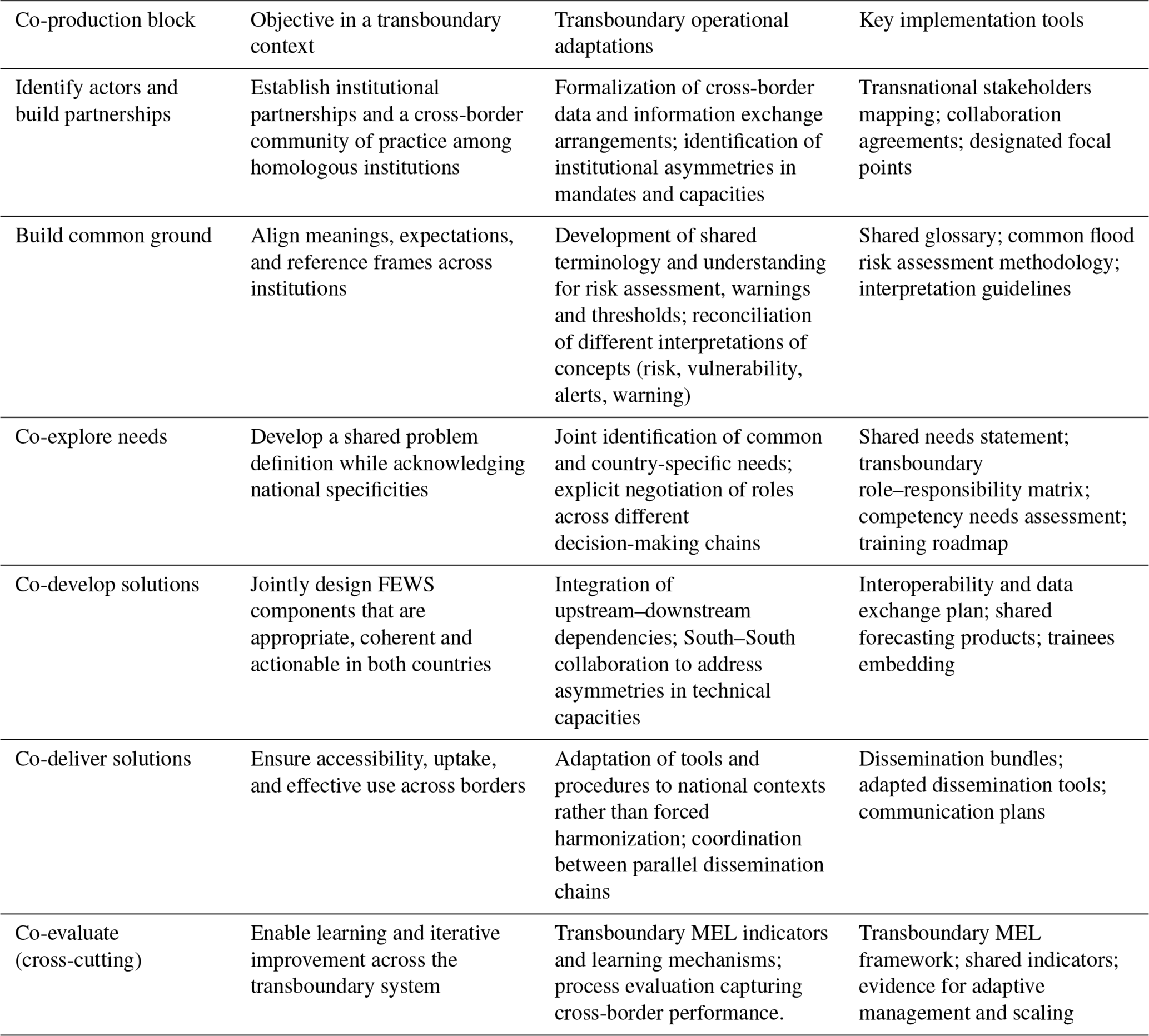
Beyond operational outcomes presented in Sect. 3.1, the implementation of the SLAPIS Sahel initiative also generated methodological lessons regarding how the co-production framework proposed by Carter et al. (2019) can be operationalized in transboundary context. Rather than introducing additional steps into the co-production cycle, the experience showed that the existing framework remains applicable provided that a set of transboundary enabling conditions is explicitly embedded within each co-production block. These operational adaptations, synthesized in Table 1, emerged inductively from the empirical implementation and constitute the principal methodological contribution of this study. Compared to non-transboundary applications, the framework explicitly accounts for cross-border data exchange, upstream–downstream dependencies, institutional asymmetries, and the coexistence of parallel decision-making chains. These elements are essential to ensure that co-produced flood early warning services remain operationally functional across national boundaries.
Table 1Operational adaptation of the co-production framework proposed by Carter et al. (2019) for transboundary FEWSs. The table summarizes the operational adaptations that emerged from the implementation of SLAPIS Sahel and the corresponding implementation tools adopted to operationalize each co-production block.
Although derived from the Sirba River experience, the proposed adaptation is intended to support the operational design of transboundary climate services in other shared river basins. Its application should however remain context-specific, reflecting differences in governance structures, institutional arrangements, and technical capacities.
The discussion addresses the three research questions addressed in this study. We first discuss the adaptations required to operationalize the co-production framework of Carter et al. (2019) in transboundary contexts. We then examine the key specificities and constraints that emerged from the implementation of SLAPIS Sahel. Finally, we discuss the available evidence regarding the added value of transboundary co-production, building on the evidence previously generated through the SLAPIS Niger experience to interpret the preliminary insights emerging from the ongoing implementation of SLAPIS Sahel.
The first research question examined whether the co-production framework proposed by Carter et al. (2019) can be effectively operationalized in a transboundary setting. The SLAPIS Sahel experience suggests that the conceptual structure of the framework remains robust and applicable to cross-border climate services, even under conditions of institutional fragmentation and asymmetric capacities. Indeed, from a methodological perspective, the SLAPIS Sahel implementation reinforces the view that co-production acts as a structuring mechanism, rather than a purely participatory add-on, particularly in transboundary settings characterized by fragmented governance. In shared river basins, where hazards propagate across borders but decision-making remains nationally bounded, co-production provides a practical means to align technical processes with parallel institutional systems. All co-production blocks were found to maintain the original logic and can be implemented and translated into operational activities, although specific adaptations are needed, and keeping in mind that a more complex setting requires greater coordination efforts and higher operating costs than a national service. This finding supports the transferability of the Carter et al. (2019) framework beyond national contexts without introducing additional phases into the co-production process, rather than embedding specific enabling conditions and implementation tools within each of the existing co-production blocks.
The second research question concerned the specific methodological requirements for extending co-production to transboundary climate services. The operational adaptations summarized in Table 1 indicate that the additional complexity of cross-border implementation does not arise from new phases in the co-production process itself, but from the need to embed transboundary enabling conditions within each co-production block. Among these, interoperability, institutional asymmetries, and long-term competency development emerged as particularly critical. The findings also support recent literature advocating a shift from harmonization to interoperability in transboundary climate services (De Filippis et al., 2022; Giuliani et al., 2017; Perego et al., 2012). While acknowledging the long-term benefits of standardized procedures, the SLAPIS Sahel experience suggests that adaptation and alignment with national procedures can be more effective for operational flood early warning in the short term. This finding empirically supports recent calls to prioritize semantic and procedural interoperability over formal harmonization (Schröter et al., 2025). Addressing institutional and capacity asymmetries emerged as another critical methodological requirement. Consistent with evidence from other co-production initiatives in Africa (Vincent et al., 2020), South–South collaboration and capacity building facilitated the transfer and assimilation of competences complementing conventional North–South approaches. This finding extends previous studies by suggesting that, in transboundary settings, South–South capacity building is not only a training modality but also a mechanism for reducing institutional asymmetries and strengthening long-term operational autonomy. More broadly, the operational adaptations summarized in Table 1 further suggest that transboundary governance should be addressed as a cross-cutting implementation requirement affecting all co-production blocks rather than as an additional phase of the process. This interpretation is consistent with the adaptive water governance literature, which emphasizes that governance performance depends on context-specific institutional arrangements and coordination mechanisms embedded throughout the governance process rather than on universal governance solutions (Pahl-Wostl et al., 2012; Pahl-Wostl, 2015).
The third research question concerned the added value generated by co-production when extended to transboundary climate services. At the current stage of implementation, this question can only be answered partially. While the evaluation of SLAPIS Niger provides robust evidence of the broader value generated by co-production, the transboundary implementation under SLAPIS Sahel is still ongoing and does not yet allow a comprehensive assessment of the additional value specifically associated with the transboundary dimension. The SLAPIS Niger experience nevertheless provides an important point of departure. Previous evaluation demonstrated that co-production generated value extending beyond the technical performance of the FEWS itself, strengthening institutional legitimacy, stakeholder ownership, and long-term partnerships (Tarchiani and Bacci, 2024). These external dimensions of value created the conditions for scaling the service beyond its initial project boundaries, enabling its geographical extension to Burkina Faso, the incorporation of additional flood risks, and the mobilization of new financial resources through trilateral cooperation. These findings are consistent with previous studies highlighting the capacity of co-production to support institutional learning, long-term engagement, and service sustainability (Meadow et al., 2015; Vincent et al., 2020; Steynor et al., 2020; Visman et al., 2022). Although still preliminary, the SLAPIS Sahel implementation already suggests additional forms of value associated with the transboundary dimension. The establishment of long-term institutional partnerships among homologous institutions, the emergence of South–South knowledge transfer and institutional learning mechanisms, and the progressive development of interoperable operational procedures indicate that transboundary co-production may generate institutional benefits that extend beyond the simple geographical expansion of an existing service.
Although these observations provide encouraging preliminary evidence, the added value specifically attributable to transboundary co-production cannot yet be comprehensively assessed. Evaluation in transboundary co-produced services must go beyond conventional performance metrics by capturing learning processes, institutional change, and cross-border coordination (Visman et al., 2022), and the evolution of collaborative governance. Further research is therefore needed to design dedicated MEL frameworks capable of documenting value creation, supporting adaptive improvement, and generating robust evidence for scaling under global initiatives such as Early Warnings for All.
Finally, two additional limitations should be acknowledged. First, the transboundary implementation of SLAPIS Sahel is still ongoing and some components of the co-produced FEWS remain only partially implemented due to operational constraints, including security conditions in parts of the basin. Second, these are the results of a single case study and a specific transboundary configuration (two countries sharing similar institutional and political context). Although the proposed operational adaptation is expected to be transferable, its broader applicability should be assessed through replication in transboundary river basins characterized by different governance arrangements, institutional capacities and risk profiles
This study examined how the co-production framework proposed by Carter et al. (2019) can be operationally adapted to support the co-development of FEWSs in transboundary river basins. The implementation of SLAPIS Sahel suggests that the original conceptual structure of the framework remains applicable in cross-border settings, provided that transboundary-specific implementation requirements are explicitly embedded within each co-production block. Rather than introducing additional phases into the co-production process, the proposed operational adaptation integrates enabling conditions and implementation tools addressing interoperability, institutional asymmetries, South–South capacity building, and parallel governance arrangements. These operational adaptations, identified through the implementation of SLAPIS Sahel, constitute the principal contribution of the present study and may support the design of climate services in other transboundary contexts.
Regarding the added value of transboundary co-production, the present study provides only preliminary evidence. Building on the institutional and operational achievements previously documented for the nationally implemented SLAPIS Niger initiative, the ongoing implementation of SLAPIS Sahel suggests that extending co-production across national borders may further strengthen institutional cooperation, facilitate knowledge exchange, and support the progressive scaling of climate services. However, the specific contribution of the transboundary dimension remains an open research question. The implementation of SLAPIS Sahel is still ongoing, some components remain only partially implemented because of operational constraints, including security conditions affecting parts of the basin. Consequently, further research, supported by dedicated Monitoring, Evaluation and Learning (MEL) frameworks capable of documenting institutional change, collaborative learning, governance evolution, and long-term service sustainability, will therefore be required to assess the added value of transboundary co-production. Finally, the findings derive from a single case study involving neighbouring countries with relatively similar institutional settings. Applying the proposed operational adaptation in transboundary basins characterized by different governance and risk profiles will provide an opportunity to assess its broader transferability.
All data produced by the SLAPIS Sahel project is publicly available at https://catalog.ibe.cnr.it/group/slapis_prj (last access: 19 August 2026).
VT and MT designed the methodology, DG, RV, MP, EB, FP, VC, MB and TdF carried out investigations. DG, RV, EB, FP and VC developed models and performed training. VT, MT and MP ensured the supervision. VT prepared the manuscript with contributions from all co-authors.
The contact author has declared that none of the authors has any competing interests.
Publisher's note: Copernicus Publications remains neutral with regard to jurisdictional claims made in the text, published maps, institutional affiliations, or any other geographical representation in this paper. The authors bear the ultimate responsibility for providing appropriate place names. Views expressed in the text are those of the authors and do not necessarily reflect the views of the publisher.
This article is part of the special issue “EMS Annual Meeting: European Conference for Applied Meteorology and Climatology 2025”. It is a result of the EMS Annual Meeting 2025, Ljubljana, Slovenia, 7–12 September 2025. The corresponding presentation was part of session ES1.3: National and international climate services: user engagement and governance.
The authors are deeply grateful to the Directors of the Niger Meteorological Service (DMN), Aissatou Sitta, and the National Meteorological Agency of Burkina Faso (ANAM), Mariam Tidiga, and to the focal points Youchaou Ousman Baoua, Lazare Sawadogo, Rakiswende Thomas Bere, Christine Tapsoba, and Moahammed Housseini Ibrahim.
The SLAPIS Sahel project has been co-founded by the Italian Agency for Development cooperation (AICS) (grant no. AID12487).
This paper was edited by Andreas Fischer and reviewed by Guadalupe Ortiz and one anonymous referee.
Aich, V., Koné, B., Hattermann, F. F., and Paton, E. N.: Time Series Analysis of Floods across the Niger River Basin, Water, 8, 165, https://doi.org/10.3390/w8040165, 2016.
Belcore, E., De Filippis, T., Ganora, D., Piras, M., Tarchiani, V., Tiepolo, M., and Vesipa, R.: Geospatial Capacity Building for Flood Resilience in the Sahel: the SLAPIS project case study, The International Archives of the Photogrammetry, Remote Sensing and Spatial Information Sciences, XLVIII-5–2024, 1–7, https://doi.org/10.5194/isprs-archives-XLVIII-5-2024-1-2024, 2024.
Born, L.: Recommendations for climate services good practice, CCAFS Working Paper no. 396, CGIAR Research Program on Climate Change, Agriculture and Food Security (CCAFS), Wageningen, the Netherlands, https://hdl.handle.net/10568/116952 (last access: 19 August 2026), 2021.
Bremer, S., Wardekker, A., Dessai, S., Sobolowski, S., Slaattelid, R., and van der Sluijs, J.: Toward a multi-faceted conception of co-production of climate services, Climate Services, 13, 42–50, https://doi.org/10.1016/j.cliser.2019.01.003, 2019.
Carter, S., Steynor, A., Vincent, K., Visman, E., and Waagsaether, K.: Co-production in African weather and climate services, 2nd edn., Future Climate for Africa and Weather and Climate Information Services for Africa, Cape Town, South Africa, https://futureclimateafrica.org/coproduction-manual (last access: 19 August 2026), 2019.
Chagnaud, G., Panthou, G., Vischel, T., and Lebel, T.: A synthetic view of rainfall intensification in the West African Sahel, Environ. Res. Lett., 17, 044005, https://doi.org/10.1088/1748-9326/ac4a9c, 2022.
Daniels, E., Bharwani, S., and Butterfield, R.: The Tandem framework: a holistic approach to co-designing climate services, SEI Discussion Brief, Stockholm Environment Institute, Stockholm, Sweden, https://www.sei.org/publications/the-tandem-framework-a-holistic-approach-to-co-designing-climate-services/ (last access: 19 August 2026), 2019.
De Filippis, T., Rocchi, L., Massazza, G., Pezzoli, A., Rosso, M., Housseini Ibrahim, M., and Tarchiani, V.: Hydrological Web Services for Operational Flood Risk Monitoring and Forecasting at Local Scale in Niger, ISPRS Int. Geo-Inf., 11, 236, https://doi.org/10.3390/ijgi11040236, 2022.
Descroix, L., Guichard, F., Grippa, M., Lambert, L. A., Panthou, G., Mahé, G., Gal, L., Dardel, C., Quantin, G., Kergoat, L., Bouaïta, Y., Hiernaux, P., Vischel, T., Pellarin, T., Faty, B., Wilcox, C., Malam Abdou, M., Mamadou, I., Vandervaere, J.-P., Diongue-Niang, A., Ndiaye, O., Sané, Y., Dacosta, H., Gosset, M., Cassé, C., Sultan, B., Barry, A., Amogu, O., Nka Nnomo, B., Barry, A., and Paturel, J.-E.: Evolution of Surface Hydrology in the Sahelo-Sudanian Strip: An Updated Review, Water, 10, 748, https://doi.org/10.3390/w10060748, 2018.
Diop, S. B., Tramblay, Y., Bodian, A., Ekolu, J., Rouché, N., and Dieppois, B.: Flood Frequency Analysis in West Africa, J. Flood Risk Manage., 18, e70001, https://doi.org/10.1111/jfr3.70001, 2025.
Elagib, N. A., Zayed, I. S. A., Saad, S. A. G., Mahmood, M. I., Basheer, M., and Fink, A. H.: Debilitating floods in the Sahel are becoming frequent, J. Hydrol., 599, 126362, https://doi.org/10.1016/j.jhydrol.2021.126362, 2021.
Fiorillo, E., Crisci, A., Issa, H., Maracchi, G., Morabito, M., and Tarchiani, V.: Recent Changes of Floods and Related Impacts in Niger Based on the ANADIA Niger Flood Database, Climate, 6, 59, https://doi.org/10.3390/cli6030059, 2018.
Giuliani, G., Nativi, S., Obregon, A., Beniston, M., and Lehmann, A.: Spatially enabling the Global Framework for Climate Services: Reviewing geospatial solutions to efficiently share and integrate climate data & information, Climate Services, 8, 44–58, https://doi.org/10.1016/j.cliser.2017.08.003, 2017.
Hewitt, C. D. and Stone, R.: Climate services for managing societal risks and opportunities, Climate Services, 23, 100240, https://doi.org/10.1016/j.cliser.2021.100240, 2021.
Lemos, M. C., Kirchhoff, C. J., and Ramprasad, V.: Narrowing the climate information usability gap, Nat. Clim. Change, 2, 789–794, https://doi.org/10.1038/nclimate1614, 2012.
Massazza, G., Tamagnone, P., Wilcox, C., Belcore, E., Pezzoli, A., Vischel, T., Panthou, G., Ibrahim, M. H., Tiepolo, M., Tarchiani, V., and Rosso, M.: Flood Hazard Scenarios of the Sirba River (Niger): Evaluation of the Hazard Thresholds and Flooding Areas, Water, 11, https://doi.org/10.3390/w11051018, 2019.
Massazza, G., Tarchiani, V., Andersson, J. C. M., Ali, A., Ibrahim, M. H., Pezzoli, A., De Filippis, T., Rocchi, L., Minoungou, B., Gustafsson, D., and Rosso, M.: Downscaling Regional Hydrological Forecast for Operational Use in Local Early Warning: HYPE Models in the Sirba River, Water, 12, https://doi.org/10.3390/w12123504, 2020.
Massazza, G., Bacci, M., Descroix, L., Ibrahim, M. H., Fiorillo, E., Katiellou, G. L., Panthou, G., Pezzoli, A., Rosso, M., Sauzedde, E., Terenziani, A., De Filippis, T., Rocchi, L., Burrone, S., Tiepolo, M., Vischel, T., and Tarchiani, V.: Recent Changes in Hydroclimatic Patterns over Medium Niger River Basins at the Origin of the 2020 Flood in Niamey (Niger), Water, 13, https://doi.org/10.3390/w13121659, 2021.
Meadow, A. M., Ferguson, D. B., Guido, Z., Horangic, A., Owen, G., and Wall, T.: Moving toward the Deliberate Coproduction of Climate Science Knowledge, Weather Clim. Soc., 7, 179–191, https://doi.org/10.1175/WCAS-D-14-00050.1, 2015.
Pahl-Wostl, C.: Water Governance in the Face of Global Change: From Understanding to Transformation, Water Governance – Concepts, Methods, and Practice, Springer International Publishing, Cham, https://doi.org/10.1007/978-3-319-21855-7, 2015.
Pahl-Wostl, C.: The role of governance modes and meta-governance in the transformation towards sustainable water governance, Environ. Sci. Policy, 91, 6–16, https://doi.org/10.1016/j.envsci.2018.10.008, 2019.
Pahl-Wostl, C., Lebel, L., Knieper, C., and Nikitina, E.: From applying panaceas to mastering complexity: Toward adaptive water governance in river basins, Environ. Sci. Policy, 23, 24–34, https://doi.org/10.1016/j.envsci.2012.07.014, 2012.
Panthou, G., Lebel, T., Vischel, T., Quantin, G., Sane, Y., Ba, A., Ndiaye, O., Diongue-Niang, A., and Diopkane, M.: Rainfall intensification in tropical semi-arid regions: the Sahelian case, Environ. Res. Lett., 13, 064013, https://doi.org/10.1088/1748-9326/aac334, 2018.
Passerotti, G., Massazza, G., Pezzoli, A., Bigi, V., Zsótér, E., and Rosso, M.: Hydrological Model Application in the Sirba River: Early Warning System and GloFAS Improvements, Water, 12, 620, https://doi.org/10.3390/w12030620, 2020.
Perego, A., Fugazza, C., Vaccari, L., Lutz, M., Smits, P., Kanellopoulos, I., and Schade, S.: Harmonization and Interoperability of EU Environmental Information and Services, IEEE Intelligent Systems, https://doi.org/10.1109/MIS.2012.22, 2012.
Sauzedde, E., Vischel, T., Panthou, G., Tarchiani, V., Massazza, G., and Housseini Ibrahim, M.: Compound-event analysis in non-stationary hydrological hazards: a case study of the Niger River in Niamey, Hydrol. Sci. J., 70, 406–421, https://doi.org/10.1080/02626667.2024.2435534, 2025.
Schröter, K., Schweizer, P.-J., Gräler, B., Cumiskey, L., Bharwani, S., Parviainen, J., Kropf, C. M., Håkansson, V. W., Drews, M., Irvine, T., Dondi, C., Apel, H., Löhrlein, J., Hochrainer-Stigler, S., Bagli, S., Huszti, L., Genillard, C., Unguendoli, S., Hattermann, F., and Steinhausen, M.: Invited perspectives: Fostering interoperability of data, models, communication, and governance for disaster resilience through transdisciplinary knowledge co-production, Nat. Hazards Earth Syst. Sci., 25, 3055–3073, https://doi.org/10.5194/nhess-25-3055-2025, 2025.
Steynor, A., Lee, J., and Davison, A.: Transdisciplinary co-production of climate services: a focus on process, Soc. Dynamics, 46, 414–433, https://doi.org/10.1080/02533952.2020.1853961, 2020.
Street, R. B.: Towards a leading role on climate services in Europe: A research and innovation roadmap, Climate Services, 1, 2–5, https://doi.org/10.1016/j.cliser.2015.12.001, 2016.
Street, R. B., Buontempo, C., Mysiak, J., Karali, E., Pulquério, M., Murray, V., and Swart, R.: How could climate services support disaster risk reduction in the 21st century, Int. J. Disast. Risk Re., 34, 28–33, https://doi.org/10.1016/j.ijdrr.2018.12.001, 2019.
Tangam, I. S., Yonaba, R., Ibrahim, B., Adamou, M. M., and Karambiri, H.: Hydrological drivers of flooding in Niamey (Niger): the role of the Sirba River, Environ. Res. Commun., 7, 015029, https://doi.org/10.1088/2515-7620/adaac9, 2025.
Tarchiani, V. and Bacci, M.: The added value of the process in climate services co-production: Lessons from Niger, Climate Services, 33, 100435, https://doi.org/10.1016/j.cliser.2023.100435, 2024.
Tarchiani, V., Massazza, G., Rosso, M., Tiepolo, M., Pezzoli, A., Ibrahim, M. H., Katiellou, G. L., Tamagnone, P., De Filippis, T., Rocchi, L., Marchi, V., and Rapisardi, E.: Community and Impact Based Early Warning System for Flood Risk Preparedness: The Experience of the Sirba River in Niger, Sustainability, 12, https://doi.org/10.3390/su12051802, 2020.
Tarchiani, V., Pasi, F., Bere, R. T., Sayri, Y. A., Gozzini, B., and Capecchi, V.: From training to transformation: co-producing sustainable early warning competence in West Africa, Climate Services, 42, 100659, https://doi.org/10.1016/j.cliser.2026.100659, 2026.
Tarhule, A.: Damaging Rainfall and Flooding: The Other Sahel Hazards, Clim. Change, 72, 355–377, https://doi.org/10.1007/s10584-005-6792-4, 2005.
Tiepolo, M., Rosso, M., Massazza, G., Belcore, E., Issa, S., and Braccio, S.: Flood Assessment for Risk-Informed Planning along the Sirba River, Niger, Sustainability, 11, 4003, https://doi.org/10.3390/su11154003, 2019.
Tiepolo, M., Braccio, S., Fiorillo, E., Galligari, A., Katiellou, G. L., Massazza, G., and Tarchiani, V.: Participatory risk assessment of pluvial floods in four towns of Niger, Int. J. Disast. Risk Re., 84, 103454, https://doi.org/10.1016/j.ijdrr.2022.103454, 2023.
Tiepolo, M., Abraiz, M., Bacci, M., Baoua, O., Belcore, E., Cannella, G., Fiorillo, E., Ganora, D., Housseini, M. I., Katiellou, G. L., Piras, M., Saretto, F., and Tarchiani, V.: Flood Damage Risk Mapping Along the River 75 Niger: Ten Benefits of a Participated Approach, Climate, 13, 80, https://doi.org/10.3390/cli13040080, 2025.
Tiepolo, M., Housseini, M. I., Cannella, G., Katiellou, G. L., Ganora, D., Marmolejo Gutierrez, A., Saretto F., Tarchiani, V., and Vesipa, R.: The contribution of fine-grained exposure to flood risk assessment along the Niger River, Nat. Hazards, 122, 554, https://doi.org/10.1007/s11069-026-08308-1, 2026.
UNISDR: 2009 UNISDR terminology on disaster risk reduction, UNDRR, https://digitallibrary.un.org/record/3967528?v=pdf (last access: 19 August 2026), 2009.
Vaughan, C. and Dessai, S.: Climate services for society: origins, institutional arrangements, and design elements for an evaluation framework, WIREs Clim. Change, 5, 587–603, https://doi.org/10.1002/wcc.290, 2014.
Vincent, K., Daly, M., Scannell, C., and Leathes, B.: What can climate services learn from theory and practice of co-production?, Climate Services, 12, 48–58, https://doi.org/10.1016/j.cliser.2018.11.001, 2018.
Vincent, K., Carter, S., Steynor, A., Visman, E., and Wågsæther, K. L.: Addressing power imbalances in co-production, Nat. Clim. Chang., 10, 877–878, https://doi.org/10.1038/s41558-020-00910-w, 2020.
Vincent, K., Steynor, A., McClure, A., Visman, E., Waagsaether, K. L., Carter, S., and Mittal, N.: Co-production: Learning from Contexts, in: Climate Risk in Africa: Adaptation and Resilience, edited by: Conway, D. and Vincent, K., Springer International Publishing, Cham, 37–56, https://doi.org/10.1007/978-3-030-61160-6_3, 2021.
Visman, E., Vincent, K., Steynor, A., Karani, I., and Mwangi, E.: Defining metrics for monitoring and evaluating the impact of co-production in climate services, Climate Services, 26, 100297, https://doi.org/10.1016/j.cliser.2022.100297, 2022.
Weichselgartner, J. and Arheimer, B.: Evolving Climate Services into Knowledge–Action Systems, Weather Clim. Soc., 11, 385–399, https://doi.org/10.1175/WCAS-D-18-0087.1, 2019.
Wilcox, C., Vischel, T., Panthou, G., Bodian, A., Blanchet, J., Descroix, L., Quantin, G., Cassé, C., Tanimoun, B., and Kone, S.: Trends in hydrological extremes in the Senegal and Niger Rivers, J. Hydrol., 566, 531–545, https://doi.org/10.1016/j.jhydrol.2018.07.063, 2018.
WMO: EARLY WARNINGS FOR ALL, WMO, Geneva, Switzerland, https://library.wmo.int/records/item/58209-early-warnings-for-all (last access: 19 August 2026), 2022.
WMO: Italian-African cooperation to strengthen early warnings in the Sahel, https://wmo.int/media/news-from-members/italian-african-cooperation-strengthen-early-warnings-sahel (last access: 8 July 2026), 2025.