Frost days in the beginning of the growing season for Norway

Helga Therese Tilley Tajet
CORRESPONDING AUTHOR
Climate and Environment Department, The Norwegian Meteorological Institute, Henrik Mohns Plass 1, 0371 Oslo, Norway
Reidun Gangstø
Climate and Environment Department, The Norwegian Meteorological Institute, Henrik Mohns Plass 1, 0371 Oslo, Norway
Andreas Dobler
Climate and Environment Department, The Norwegian Meteorological Institute, Henrik Mohns Plass 1, 0371 Oslo, Norway
Inger Hanssen-Bauer
Climate and Environment Department, The Norwegian Meteorological Institute, Henrik Mohns Plass 1, 0371 Oslo, Norway
Hans Olav Hygen
Climate and Environment Department, The Norwegian Meteorological Institute, Henrik Mohns Plass 1, 0371 Oslo, Norway
Related authors
No articles found.
Elin Lundstad, Andreas Dobler, Michael Taylor, and Magnus Joelsson
EGUsphere, https://doi.org/10.5194/egusphere-2026-3936, https://doi.org/10.5194/egusphere-2026-3936, 2026
This preprint is open for discussion and under review for Climate of the Past (CP).
Short summary
Short summary
Early weather records help us understand how climate has changed over the past centuries, but many contain gaps and inconsistencies. We compared three automated methods for improving these records using a global collection of historical temperature observations. Although the methods differed in how they treated incomplete data, all successfully recovered the main climate signal. The results provide a stronger foundation for reconstructing past climate and improving future climate research.
Shaochun Huang, Wai Kwok Wong, Andreas Dobler, Sigrid Jørgensen Bakke, Stein Beldring, Ingjerd Haddeland, Hans Olav Hygen, Tyge Løvset, Stephanie Mayer, Kjetil Melvold, Irene Brox Nilsen, Gusong Ruan, Silje Lund Sørland, and Anita Verpe Dyrrdal
Geosci. Model Dev., 19, 4567–4599, https://doi.org/10.5194/gmd-19-4567-2026, https://doi.org/10.5194/gmd-19-4567-2026, 2026
Short summary
Short summary
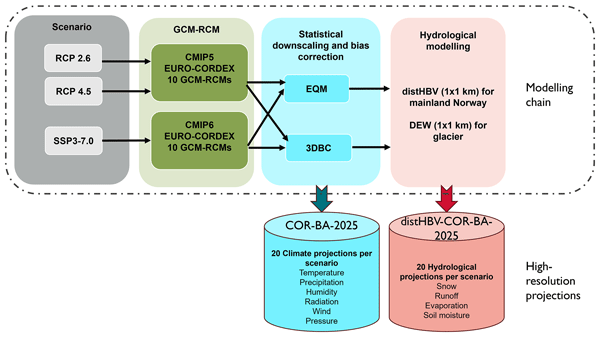
This paper documents the improved model experiment, which is used to generate the most updated, comprehensive and detailed climate and hydrological projections for the national climate assessment report for Norway published in October 2025. The new bias-adjusted daily high-resolution climate and hydrological projections are openly accessible and will serve as a knowledge base for climate change adaptation to decision makers at various administrative levels in Norway.
Andreas Dobler, Rasmus Benestad, Julia Lutz, and Kajsa Maria Parding
EGUsphere, https://doi.org/10.5194/egusphere-2026-207, https://doi.org/10.5194/egusphere-2026-207, 2026
Short summary
Short summary
We propose a framework summarising the scaling of sub-daily to daily wet-spell frequencies and intensities in two single parameters. Results show a shift towards fewer but more intense precipitation hours on rainy days. Our study further demonstrates the values of high-resolution regional climate model simulations for testing hypotheses in contexts where long-term observational networks are lacking, and how empirical-statistical and dynamical downscaling results can be used together.
Kun Xie, Lu Li, Hua Chen, Stephanie Mayer, Andreas Dobler, Chong-Yu Xu, and Ozan Mert Göktürk
Hydrol. Earth Syst. Sci., 29, 2133–2152, https://doi.org/10.5194/hess-29-2133-2025, https://doi.org/10.5194/hess-29-2133-2025, 2025
Short summary
Short summary
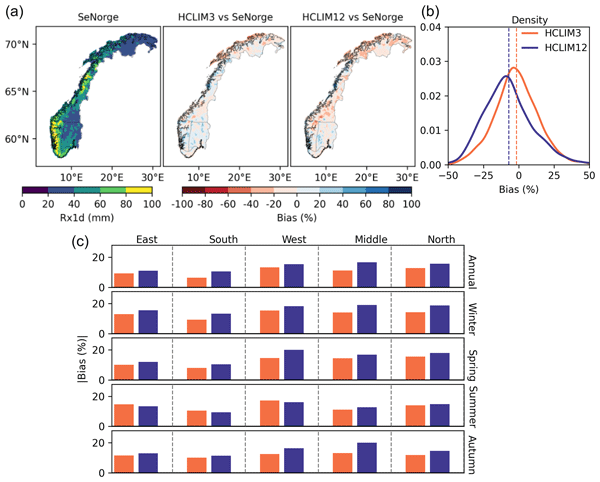
We compared hourly and daily extreme precipitation across Norway from HARMONIE Climate models at convection-permitting 3 km (HCLIM3) and 12 km (HCLIM12) resolutions. HCLIM3 more accurately captures the extremes in most regions and seasons (except in summer). Its advantages are more pronounced for hourly extremes than for daily extremes. The results highlight the value of convection-permitting models in improving extreme-precipitation predictions and in helping the local society brace for extreme weather.
Rasmus E. Benestad, Kajsa M. Parding, and Andreas Dobler
Hydrol. Earth Syst. Sci., 29, 45–65, https://doi.org/10.5194/hess-29-45-2025, https://doi.org/10.5194/hess-29-45-2025, 2025
Short summary
Short summary
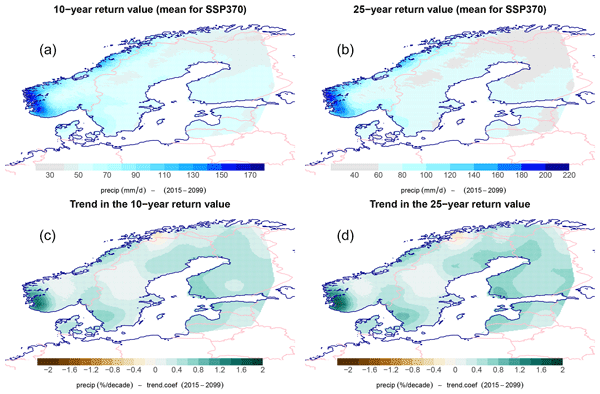
We present a new method to calculate the chance of heavy downpour and the maximum rainfall expected over a 25-year period. It is designed to analyse global climate models' reproduction of past and future climates. For the Nordic countries, it projects a wetter climate in the future with increased intensity but not necessarily more wet days. The analysis also shows that rainfall intensity is sensitive to future greenhouse gas emissions, while the number of wet days appears to be less affected.
Rasmus E. Benestad, Abdelkader Mezghani, Julia Lutz, Andreas Dobler, Kajsa M. Parding, and Oskar A. Landgren
Geosci. Model Dev., 16, 2899–2913, https://doi.org/10.5194/gmd-16-2899-2023, https://doi.org/10.5194/gmd-16-2899-2023, 2023
Short summary
Short summary
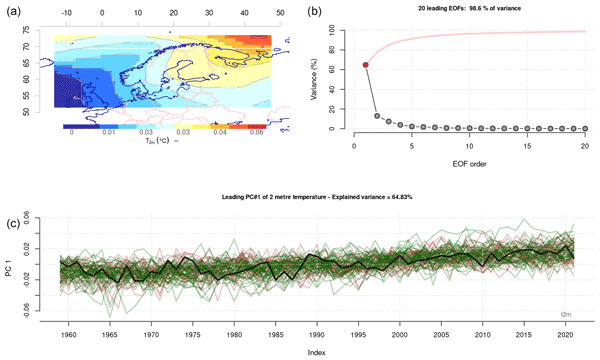
A mathematical method known as common EOFs is not widely used within the climate research community, but it offers innovative ways of evaluating climate models. We show how common EOFs can be used to evaluate large ensembles of global climate model simulations and distill information about their ability to reproduce salient features of the regional climate. We can say that they represent a kind of machine learning (ML) for dealing with big data.
Erika Médus, Emma D. Thomassen, Danijel Belušić, Petter Lind, Peter Berg, Jens H. Christensen, Ole B. Christensen, Andreas Dobler, Erik Kjellström, Jonas Olsson, and Wei Yang
Nat. Hazards Earth Syst. Sci., 22, 693–711, https://doi.org/10.5194/nhess-22-693-2022, https://doi.org/10.5194/nhess-22-693-2022, 2022
Short summary
Short summary
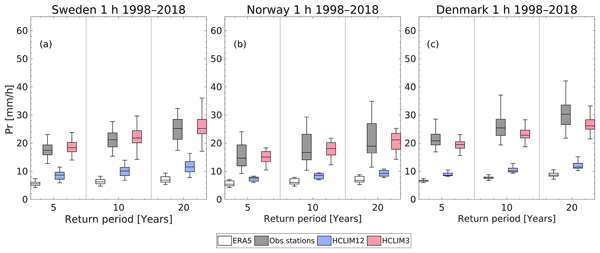
We evaluate the skill of a regional climate model, HARMONIE-Climate, to capture the present-day characteristics of heavy precipitation in the Nordic region and investigate the added value provided by a convection-permitting model version. The higher model resolution improves the representation of hourly heavy- and extreme-precipitation events and their diurnal cycle. The results indicate the benefits of convection-permitting models for constructing climate change projections over the region.
Cited articles
Augspurger, C. K.: Reconstructing patterns of temperature, phenology, and frost damage over 124 years: Spring damage risk is increasing, Ecology, 94, 41–50, https://doi.org/10.1890/12-0200.1, 2013.
Buaas, T. O., Simonsen, S. W., and Lindgren, H. M.: Jostein fortviler: – Ikke et eneste eple på 13.000 epletrær (“Jostein despairs: – Not a single apple in 13,000 apple trees”), NRK, https://www.nrk.no/vestfoldogtelemark/far-eplesesongen-odelagt-av-frost-1.14542678, (last access: 10 March 2026), 2019.
Carter, T. R.: Changes in the thermal growing season in Nordic countries during the past century and prospects for the future, AFSci., 7, 161–179, https://doi.org/10.23986/afsci.72857, 1998.
Cornes, R. C., van der Schrier, G., and Squintu, A. A.: A reappraisal of the thermal growing season length across Europe, Int. J. Climatol.,39, 1787–1795, https://doi.org/10.1002/joc.5913, 2019.
Dalen, R.: Nattefrost kan gi eplekrise (“Night frost may cause apple crisis”), NRK, https://www.nrk.no/buskerud/nattefrost-kan-gi-eplekrise-1.11696127, (last access: 10 March 2026), 2014.
Davis, N. E.: The variability of the onset of spring in Britain, Q. J. Roy. Meteor. Soc., 98 763–777, https://doi.org/10.1002/qj.49709841805, 1972.
Dobler, A. and Lussana, C.: seNorge_2018 v20.05 daily mean, minimum and maximum temperatures and total precipitation amounts for year 2020, Version 20.05, Zenodo [data set], https://doi.org/10.5281/zenodo.17293482, 2025.
Dobler, A., Lutz, J., Huang, S., Wong, W. K., Tveito, O. E., Haugen, J. E., Tajet, H. T. T., and Nilsen, I. B.: Projected changes in climate and hydrological indices for Norway for 2041–2070 and 2071–2100, Norwegian Meteorological Institute [data set], https://doi.org/10.21343/f828-rv60, 2025.
Dyrrdal, A. V., Bakke, S. J., Hanssen-Bauer, I., Mayer, S., Nilsen, I. B., Nilsen, J. E. Ø., Paasche, Ø., Saloranta, T., and Årthun, M. (Eds.): Klima i Norge – kunnskapsgrunnlag for klimatilpasning oppdatert i 2025, NCCS-rapport 1/2025, https://doi.org/10.60839/4rgq-nn84, 2025.
Grinde, L., Mamen, J., and Tunheim, K.: Været i Norge vårsesongen 2025, MET info 15-2025, https://www.met.no/publikasjoner/met-info/met-info-2025/_/attachment/inline/47d9d9e2-0549-4bb8-94fb-8e23bb7b0d75:9367860e65651c1fe87f828f1ae5eb931a89d5f9/MET-info-15-2025.pdf (last access: 5 October 2026), 2025.
Huang, S., Wong, W. K., Dobler, A., Bakke, S. J., Beldring, S., Haddeland, I., Hygen, H. O., Løvset, T., Mayer, S., Melvold, K., Nilsen, I. B., Ruan, G., Sørland, S. L., and Dyrrdal, A. V.: An improved modelling chain for bias-adjusted high-resolution climate and hydrological projections for Norway, Geosci. Model Dev., 19, 4567–4599, https://doi.org/10.5194/gmd-19-4567-2026, 2026.
Hufkens, K., Friedl, M. A., Keenan, T. F., Sonnentag, O., Bailey, A., O'Keefe, J., and Richardson, A. D.: Ecological impacts of a widespread frost event following early spring leaf-out, Glob. Change Biol., 18, 2365–2377, https://doi.org/10.1111/j.1365-2486.2012.02712.x, 2012.
IPCC: Climate Change 2021: The Physical Science Basis. Contribution of Working Group I to the Sixth Assessment Report of the Intergovernmental Panel on Climate Change, edited by: Masson-Delmotte, V., Zhai, P., Pirani, A., Connors, S. L., Péan, C., Berger, S., Caud, N., Chen, Y., Goldfarb, L., Gomis, M. I., Huang, M., Leitzell, K., Lonnoy, E., Matthews, J. B. R., Maycock, T. K., Waterfield, T., Yelekçi, O., Yu, R., and Zhou, B., Cambridge University Press, Cambridge, United Kingdom and New York, NY, USA, In press, https://doi.org/10.1017/9781009157896, 2021.
Jacob, D., Teichmann, C., Sobolowski, S., Katragkou, E., Anders, I., Belda, M., Benestad, R., Boberg, F., Buonomo, E., Cardoso, R. M., Casanueva, A., Christensen, O. B., Christensen, J. H., Coppola, E., De Cruz, L., Davin, E. L., Dobler, A., Dominguez, M., Fealy, R., Fernandez, J., Gaertner, M. A., García-Díez, M., Giorgi, F., Gobiet, A., Goergen, K., Gómez-Navarro, J. J., Alemán, J. J. G., Gutiérrez, C., Gutiérrez, J. M., Güttler, I., Haensler, A., Halenka, T., Jerez, S., Jiménez-Guerrero, P., Jones, R. G., Keuler, K., Kjellström, E., Knist, S., Kotlarski, S., Maraun, D., van Meijgaard, E., Mercogliano, P., Montávez, J. P., Navarra, A., Nikulin, G., Noblet-Ducoudré, N., Panitz, H. J., Pfeifer, S., Piazza, M., Pichelli, E., Pietikäinen, J. P., Prein, A. F., Preuschmann, S., Rechid, D., Rockel, B., Romera, R., Sánchez, E., Sieck, K., Soares, P. M. M., Somot, S., Srnec, L., Sørland, S. L., Termonia, P., Truhetz, H., Vautard, R., Warrach-Sagi, K., and Wulfmeyer, V.: Regional climate downscaling over Europe: perspectives from the EURO-CORDEX community, Reg. Environ. Change, 20, 51, https://doi.org/10.1007/s10113-020-01606-9, 2020.
Karl, T. R., Nicholls, N., and Ghazi, A.: Clivar/GCOS/WMO Workshop on Indices and Indicators for Climate Extremes Workshop Summary, Climatic Change, 42, 3–7, https://doi.org/10.1023/A:1005491526870, 1999.
Lile, A.: Her blir det ingen solbær (“There will be no blackcurrants here”), Ringerikes blad, https://www.ringblad.no/nyheter/her-blir-det-ingen-solbar/s/1-97-6686382, (last access: 10 March 2026), 2013.
Liu, Q., Piao, S., Janssens, I.A., Fu, Y., Peng, S., Lian, X., Ciais, P., Myneni, R. B., Peñuelas, J., and Wang, T. : Extension of the growing season increases vegetation exposure to frost, Nat. Commun., 9, 426, https://doi.org/10.1038/s41467-017-02690-y, 2018.
Lussana, C.: seNorge_2018 daily mean temperature 1957–2019, Version 20.05, Zenodo [data set], https://doi.org/10.5281/zenodo.3923706, 2020a.
Lussana, C.: seNorge_2018 daily minimum temperature 1957–2019, Version 20.05, Zenodo [data set], https://doi.org/10.5281/zenodo.3923697, 2020b.
Lussana, C.: seNorge observational gridded datasets, seNorge_2018, version 20.05, MET report 07-2020, https://www.met.no/publikasjoner/met-report/met-report-2020/_/attachment/download/9f79d391-62d8-4fc1-a61a-9f0e7f1de389:8c74ebf2118593aa75272e6aff416ce66f86e73f/MET-report-07-2020.pdf (last access: 5 October 2026), 2020c.
Lussana, C., Tveito, O. E., Dobler, A., and Tunheim, K.: seNorge_2018, daily precipitation, and temperature datasets over Norway, Earth Syst. Sci. Data, 11, 1531–1551, https://doi.org/10.5194/essd-11-1531-2019, 2019.
Ma, Q., Huang, J.-G., Hänninen, H., and Berninger, F.: Divergent trends in the risk of spring frost damage to trees in Europe with recent warming, Glob. Change Biol., 25, 351–360, https://doi.org/10.1111/gcb.14479, 2019.
Marquis, B., Bergeron, Y., Houle, D., Leduc, M., and Rossi, S.: Variability in frost occurrence under climate change and consequent risk of damage to trees of western Quebec, Canada, Sci. Rep., 12, 7220, https://doi.org/10.1038/s41598-022-11105-y, 2022.
Myrvang, S. E. and Skålevik, G. A.: Aldri opplevd så tidlig vår: – Hva skjer hvis ikke vi tilpasser oss? (“Never experienced spring this early: – What happens if we don't adapt?”), VG, https://www.vg.no/nyheter/i/PpG3dX/bonden-har-aldri-opplevd-saa-tidlig-vaar-hva-skjer-hvis-ikke-vi-tilpasser-oss (last access: 10 March 2026), 2025.
Nidzgorska-Lencewicz, J., Mąkosza, A., Koźmiński, C., and Michalska, B.: Potential Risk of Frost in the Growing Season in Poland, Agriculture, 14, 501, https://doi.org/10.3390/agriculture14030501, 2024.
Peterson, T. C., Folland, C., Gruza, G., Hogg, W., Mokssit, A., and Plummer, N.: Report on the Activities of the Working Group on Climate Change Detection and Related Rapporteurs 1998–2001, WMO, Rep. WCDMP-47, WMO-TD 1071, Geneve, Switzerland, 143 pp. https://etccdi.pacificclimate.org/docs/wgccd.2001.pdf (last access: 5 October 2026), 2001.
Sgubin, G., Swingedouw, D., Dayon, G., de Cortázar-Atauri, I. G., Ollat, N., Pagé, C., and van Leeuwen, C.: The risk of tardive frost damage in French vineyards in a changing climate, Agric. For. Meteorol., 250–251, 226–242, https://doi.org/10.1016/j.agrformet.2017.12.253, 2018.
Skaugen, T. E. and Tveito, O. E.: Growing-season and degree-day scenario in Norway for 2021–2050, Clim. Res., 26, 221–232, https://doi.org/10.3354/cr026221, 2004.
Smith, E., Grant, N., Luo, X., and Diaz, D.: Evaluating the ability of gridded climate datasets to capture temperature and precipitation trends and extremes, Sci. Rep., 15, 12607, https://doi.org/10.1038/s41598-025-97570-7, 2025.
Statistics Norway: Statistics on Land use and land cover, https://www.ssb.no/en/natur-og-miljo/areal/statistikk/arealbruk-og-arealressurser, (last access: 11 August 2026), 2026.
Storfossen, J.: Store frostskader på frukt (“Major frost damage to fruits”), Laagendalsposten, https://www.laagendalsposten.no/nyheter/store-frostskader-pa-frukt/s/2-2.1601-1.2481783, (last access: 10 March 2026), 2005.
Svystun, T., Lundströmer, J., Berlin, M., Westin, J., and Jönsson, A. M.: Model analysis of temperature impact on the Norway spruce provenance specific bud burst and associated risk of frost damage, Forest Ecol. Manag., 493, 119252, https://doi.org/10.1016/j.foreco.2021.119252, 2021.
Tajet, H. T. T., Hanssen-Bauer, I., Tveito, O. E., and Gangstø, R.: Temperaturindekser 1961–1990 og 1991–2020, MET report 2-2024, Meteorologisk institutt, https://www.met.no/publikasjoner/met-report/met-report-2024/_/attachment/inline/779096fa-079b-41be-a87a-f11c100294af:65772d3fdf9a8991da06df0a21ad38a9ce5017b3/MET-report-2-2024-Temperaturindekser 1961-1990 og 1991-2020.pdf (last access: 5 October 2026), 2024.
Tajet, H. T. T., Gangstø, R., Hanssen-Bauer, I., Dobler, A., and Hygen, H. O.: Frost i vekstsesongen for Norge, 1961–2020, MET report 09-2025, Meteorologisk institutt, https://www.met.no/publikasjoner/met-report/_/attachment/inline/6a85d48d-c7d0-4014-9c17-64842d1392df:692b728eab7afabde90b851ecff442cd2879bc05/MET rapport 9_2025 - Frost i vekstsesong, KiN bakgrunnsrapport.pdf (last access: 5 October 2026), 2025.
Vautard, R., van Oldenborgh, G. J., Bonnet, R., Li, S., Robin, Y., Kew, S., Philip, S., Soubeyroux, J.-M., Dubuisson, B., Viovy, N., Reichstein, M., Otto, F., and Garcia de Cortazar-Atauri, I.: Human influence on growing-period frosts like in early April 2021 in central France, Nat. Hazards Earth Syst. Sci., 23, 1045–1058, https://doi.org/10.5194/nhess-23-1045-2023, 2023.
Wang, J., Hua, H., Guo, J. Huang, X., Zhang, X., Yang, Y., Wang, D., Guo, X., Zhang, R., Smith, N. G., Rossi, S., Peñuelas, J. Ciais, P., Wu, C., and Chen, L.: Late spring frost delays tree spring phenology by reducing photosynthetic productivity, Nat. Clim. Change, 15, 201–209. https://doi.org/10.1038/s41558-024-02205-w, 2025.
Wong, W. K., Dobler, A., Huang, S., Beldring, S., Melvold, K., and Ruan, G.: Daily bias-adjusted climate (COR-BA-2025) and hydrological (distHBV-COR-BA-2025) projections for Norway, Norwegian Meteorological Institute at the Arctic Data Centre [data set], https://doi.org/10.21343/0k90-6w67, 2025.
Zhou, B., Zhai, P., Chen, Y. and Yu, R.: Projected changes of thermal growing season over Northern Eurasia in a 1.5 °C and 2 °C warming world, Environ. Res. Lett., 13, 035004, https://doi.org/10.1088/1748-9326/aaa6dc, 2018.
Short summary
Frost early in the growing season affects many crops and plant species. In Norway, warm early springs can trigger early flowering, followed by cold spells causing frost damage. Although warming extends the growing season, frost risk may increase at its start or end. At present, the early-season risk is highest in lowland South Norway, especially the southeast, and has increased most along the west coast. Future projections indicate an increasing risk along the coast, but decreasing risk inland.
Frost early in the growing season affects many crops and plant species. In Norway, warm early...