TV meteorologists at MET Norway as climate communicators
Anders Doksæter Sivle
CORRESPONDING AUTHOR
The Norwegian Meteorological Institute, 0313 Oslo, Norway
Amalie Kvame Holm
The Norwegian Meteorological Institute, 0313 Oslo, Norway
Jelmer Jeuring
The Norwegian Meteorological Institute, 0313 Oslo, Norway
Hans Olav Hygen
The Norwegian Meteorological Institute, 0313 Oslo, Norway
Mai-Linn Finstad Svehagen
The Norwegian Meteorological Institute, 0313 Oslo, Norway
Related authors
Kathrin Wapler and Anders Sivle
Adv. Sci. Res., 22, 87–95, https://doi.org/10.5194/asr-22-87-2025, https://doi.org/10.5194/asr-22-87-2025, 2025
Short summary
Short summary
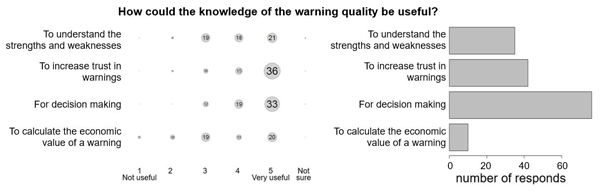
The question of how to best evaluate and communicate the value of weather warnings was addressed by a survey. This included questions with respect to the relevance of various aspects of a warning, the potential benefit of providing information on warning quality, the type of useful information and suitable ways of providing such information. Apart from the core information of warnings (time, place and severity) impact information and behavioural advice are seen to add value to a warning.
Anders Doksæter Sivle, Jelmer Jeuring, and Mai-Linn Finstad Svehagen
Adv. Sci. Res., 19, 1–8, https://doi.org/10.5194/asr-19-1-2022, https://doi.org/10.5194/asr-19-1-2022, 2022
Short summary
Short summary
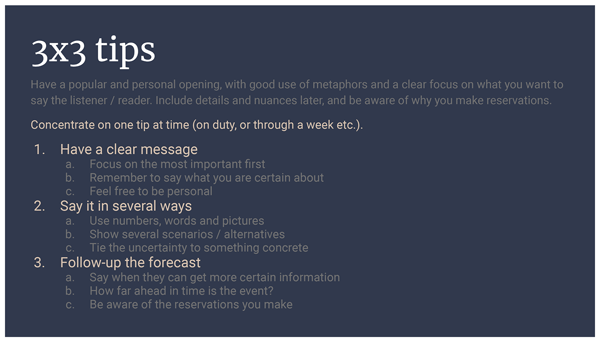
At MET Norway, a small interdisciplinary team – the Sandbox – tries to improve the communication between the meteorologists and their audience. In 2021, we focused on the communication of forecast uncertainty. The Sandbox created, with input from internal and external experts, solutions for applying linguistic and visual tools for forecasters to communicate about uncertainty. In the article, we share our experiences and lessons learned.
Kathrin Wapler and Anders Sivle
Adv. Sci. Res., 22, 87–95, https://doi.org/10.5194/asr-22-87-2025, https://doi.org/10.5194/asr-22-87-2025, 2025
Short summary
Short summary
The question of how to best evaluate and communicate the value of weather warnings was addressed by a survey. This included questions with respect to the relevance of various aspects of a warning, the potential benefit of providing information on warning quality, the type of useful information and suitable ways of providing such information. Apart from the core information of warnings (time, place and severity) impact information and behavioural advice are seen to add value to a warning.
Shaochun Huang, Wai Kwok Wong, Andreas Dobler, Sigrid Jørgensen Bakke, Stein Beldring, Ingjerd Haddeland, Hans Olav Hygen, Tyge Løvset, Stephanie Mayer, Kjetil Melvold, Irene Brox Nilsen, Gusong Ruan, Silje Lund Sørland, and Anita Verpe Dyrrdal
EGUsphere, https://doi.org/10.5194/egusphere-2025-5331, https://doi.org/10.5194/egusphere-2025-5331, 2025
This preprint is open for discussion and under review for Geoscientific Model Development (GMD).
Short summary
Short summary
This paper documents the model experiment used to generate the most updated, comprehensive and detailed climate and hydrological projections for the national climate assessment report for Norway published in October 2025. The new datasets (COR-BA-2025 and distHBV-COR-BA-2025) of these projections are openly accessible and will serve as a knowledge base for climate change adaptation to decision makers at various administrative levels in Norway.
Anders Doksæter Sivle, Jelmer Jeuring, and Mai-Linn Finstad Svehagen
Adv. Sci. Res., 19, 1–8, https://doi.org/10.5194/asr-19-1-2022, https://doi.org/10.5194/asr-19-1-2022, 2022
Short summary
Short summary
At MET Norway, a small interdisciplinary team – the Sandbox – tries to improve the communication between the meteorologists and their audience. In 2021, we focused on the communication of forecast uncertainty. The Sandbox created, with input from internal and external experts, solutions for applying linguistic and visual tools for forecasters to communicate about uncertainty. In the article, we share our experiences and lessons learned.
M. Bazlur Rashid, Syed Shahadat Hossain, M. Abdul Mannan, Kajsa M. Parding, Hans Olav Hygen, Rasmus E. Benestad, and Abdelkader Mezghani
Adv. Sci. Res., 18, 99–114, https://doi.org/10.5194/asr-18-99-2021, https://doi.org/10.5194/asr-18-99-2021, 2021
Short summary
Short summary
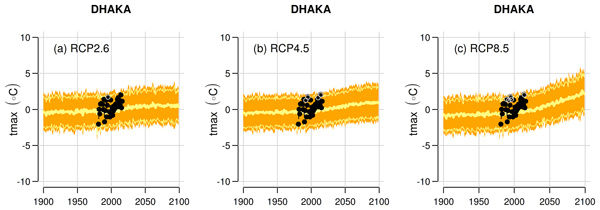
This study presents estimates of the maximum temperature in Bangladesh for the 21st century for the pre-monsoon season (March–May), the hottest season in Bangladesh. The maximum temperature is important as indicator of the frequency and severity of heatwaves. Several emission scenarios were considered assuming different developments in the emission of greenhouse gases. Results show that there will likely be a heating of at least 1 to 2 degrees Celsius.
Cited articles
Arnslett, A., Bjørnæs, C., and Lannoo, E.: Effektiv klimakommunikasjon
– Trender og fakta 2018, Report by CICERO, CICERO, Oslo, Norway, 2018.
Corner, A.: Come on, UK weather forecasters – tell it like it is on climate
change, The Guardian, 20 March 2019.
Corner, A., Webster, R., and Teriete, C: Climate Visuals: Seven principles for visual climate change communication (based on international social
research), Clim. Outreach, Oxford, 2015.
Feygina, I., Myers, T., Placky, B., Sublette, S., Souza, T., Toohey-Morales,
J., and Maibach, E.: Localized climate reporting by TV weathercasters
enhances public understanding of climate change as a local problem: Evidence
from a randomized controlled experiment, B. Am. Meteorol. Soc., 101,
1092–1100, 2020.
Fischhoff, B.: Nonpersuasive communication about matters of greatest
urgency, Climatic Change, 41, 7204–7208, 2007.
Holm, A. K., Sivle, A. D., Jeuring, J., and Svehagen, M. L. F.: Climate
Communication: TV meteorologists as Climate Communicators, MET Report No. 12/2020, The Norwegian Meteorological institute, Oslo, Norway, 2020.
Holmes, D., Hall, S., and Robinson, E.: The 2017 Australian Weather Presenter
Survey: Initial Findings, Monash Climate Change Communication Research Hub,
Monash University, Melbourne, 38 pp., 2017.
Ipsos: Bruk av og tiltro til værvarsling, På oppdrag for
Meteorologisk institutt, Annual polling for 2019 and 2020 [Use of and trust
in weather forecasting], Insights can be given upon request, 2019/2020.
Maibach, E., Cullen, H., Placky, B., Witte, J., Seitter, K., Gardiner, N.,
Myers, T., and Sublette, S.: TV meteorologists as local climate educators.
Oxford Research Encyclopedia of Climate Science, Oxford, 2016.
Markowitz, E., Hodge, C., and Harp, G.: Connecting on Climate: A Guide to
Effective Climate Change Communication. The Center for Research on
Environmental Decisions linked to The Earth Institute, Columbia University
and ecoAmerica, New York and Washington, D.C., 2014.
Myers, T., Maibach, E., Placky, B., Henry, K., Slater, M., and Seitter, K.:
Impact of the Climate Matters Program on Public Understanding of Climate
Change, Weather, Clim. Soc., 12, 836–876, 2020.
NRK: Velge og bli valgt: NRKs årsrapport og årsregnskap for 2019, NRK, Oslo, Norway, 2019.
Perkins D. R., Timm, K., Myers, T., and Maibach, E.: Broadcast Meteorologists' views on climate change: A state-of-the-community review,
Weather Clim. Soc., 12, 249–262, 2020.
Poortvliet, P. M., Niles, M. T., Veraart, J. A., Werners, S. E., Korporaal,
F. C., and Mulder, B. C.: Communicating Climate Change Risk: A Content
Analysis of IPCC's Summary for Policymakers, Sustainability, 12, 4861, https://doi.org/10.3390/su12124861, 2020.
Timm, K. M., Perkins, D., Myers, T., Placky, B. W., and Maibach, E. W.:
Reporting on climate change by broadcast meteorologists: A national
assessment, B. Am. Meteorol. Soc., 101, 129–140, 2020.
Short summary
The Norwegian Meteorological Institute initiated the project
TV meteorologists as climate communicatorsin 2019. Our goal was to make it easier for people to understand climate change and how it relates to local weather. The TV meteorologists have received extended training in climate issues, and in the last two years they have had 40 TV-appearances focusing on different local climate issues on the NRK Evening news. The majority of the stories have also been shared through social media.
The Norwegian Meteorological Institute initiated the project
TV meteorologists as climate...